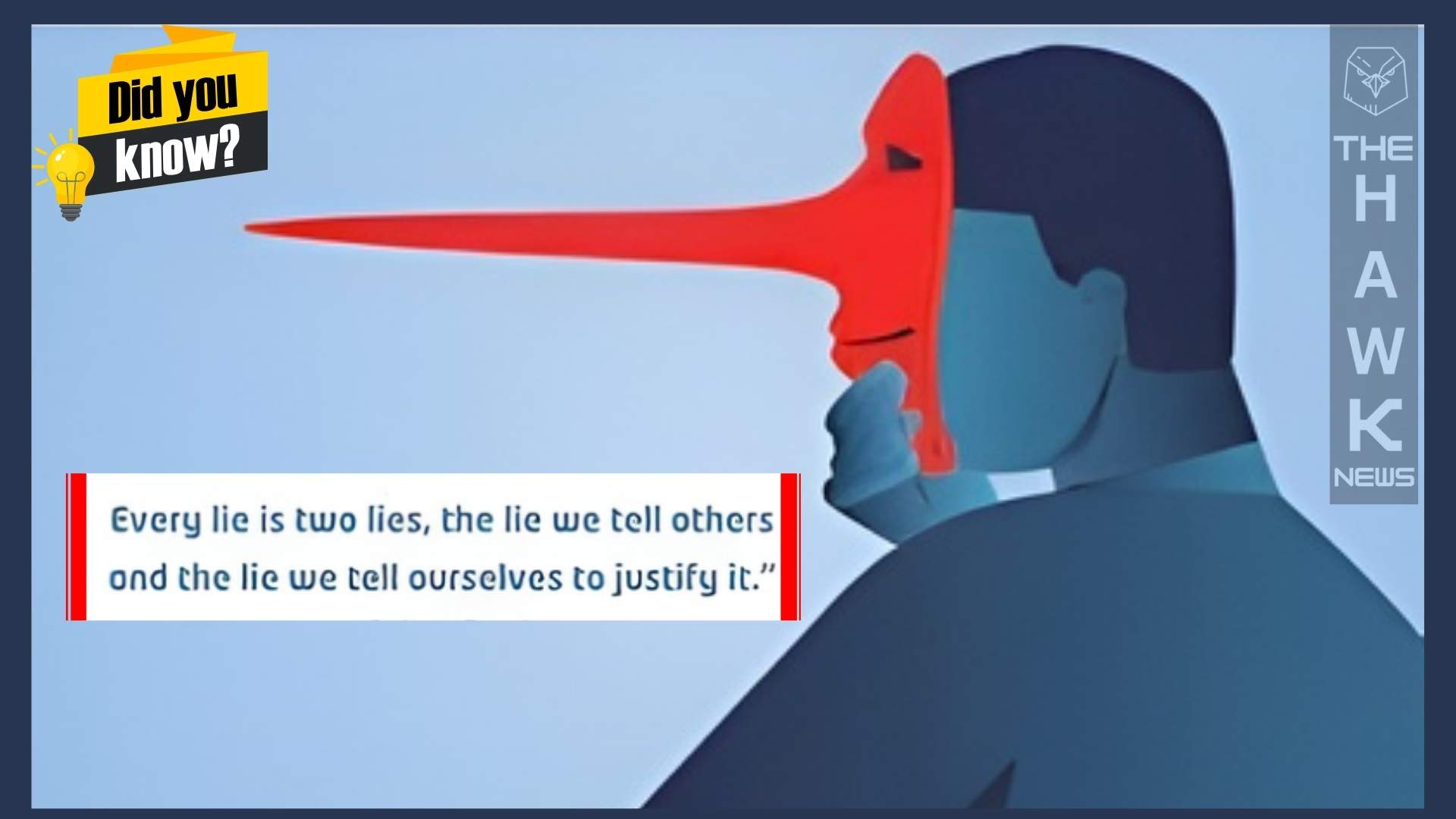
The illustration is deceptively simple: a man with an impossibly long nose, Pinocchio-like, stretching forward as he speaks. Beneath it sits a quiet but piercing line from writer Robert Brault:
“Every lie is two lies: the lie we tell others, and the lie we tell ourselves to justify it.”
At first glance, it feels philosophical. On closer inspection, it feels uncomfortably personal.
Because the most dangerous lies are rarely spoken aloud. They live inside us, polished, repeated, and eventually believed.
The First Lie: Performance for the World
We live in an era where honesty competes with aesthetics.
Social media encourages curated truth: the best angle, the happiest moment, the strongest opinion compressed into seconds.
Filters soften faces, captions soften reality.
A bad day becomes a “learning curve.” Loneliness becomes “self-care.” Exhaustion becomes “the grind.”
This is not always malicious. Often, it is survival.
In 2019, former Facebook executive Chamath Palihapitiya admitted that platforms were designed to exploit psychological vulnerabilities.
“We created tools that rip apart the social fabric of how society works,” he said.
When visibility becomes currency, honesty becomes risky.
So we tell the first lie to employers, friends, followers, even family:
“I’m fine.”
“I’ve got this.”
“This is who I am.”
Over time, the performance becomes a habit.
The Second Lie: The One That Settles In
The more insidious lie is the one that follows.
Psychologists call it cognitive dissonance, the mental discomfort of holding conflicting beliefs. To reduce it, we don’t always change our behavior. We change the story.
A famous experiment by psychologist Leon Festinger showed that when people are paid a small amount to lie, they are more likely to convince themselves the lie is true.
Why? Because the mind prefers internal consistency over truth.
This is how justification works:
- “Everyone exaggerates online.”
- “If I slow down, I’ll fall behind.”
- “This isn’t lying, it’s protecting myself.”
Eventually, the mask stops feeling heavy. Not because it fits but because we forget it’s there.
When Self-Deception Turns Costly
History offers sobering examples of self-deception scaling into disaster.
In 2008, Lehman Brothers collapsed after executives dismissed internal warnings about risky investments.
Emails later revealed a culture of denial, leaders reassuring themselves even as evidence mounted. The lie was not only to investors. It was inward: “This is temporary. We’re too big to fail.”
On a personal level, the costs are quieter but no less real.
A 2021 study published in Frontiers in Psychology linked chronic self-deception to anxiety, burnout, and identity confusion, especially among young adults navigating high-pressure digital environments.
When you lie to yourself long enough, you lose the ability to name what you actually feel.
Why the Younger Generation Feels It More
For the younger generation, identity is not static; it is constantly performed.
Careers are uncertain. Relationships are fluid. Algorithms reward confidence, not clarity.
In such a world, admitting “I don’t know” feels like falling behind.
Author Brené Brown puts it simply:
“Owning our story and loving ourselves through that process is the bravest thing that we’ll ever do.”
But bravery is harder when vulnerability is monetized and mistakes are archived forever.
So the second lie becomes a coping mechanism: If I believe my own narrative, maybe I won’t have to confront the gap between who I am and who I present.
The Long Nose Effect
The illustration’s exaggerated nose matters.
It reminds us that lies distort perception. The more we lean into them, the more warped reality becomes. What starts as protection turns into pressure. What starts as aspiration turns into impostor syndrome.
Ironically, the people who seem most put-together are often those carrying the heaviest internal contradictions.
As writer David Foster Wallace warned:
“The most obvious, important realities are often the ones that are hardest to see and talk about.”
Especially when we are busy convincing ourselves they don’t exist.
So What Do We Do? Practical Ways Back to Truth
This is not a call for brutal honesty or public confession. It is a call for private alignment.
1. Practice Micro-Honesty
Start small. Admit fatigue. Name uncertainty. Journal without an audience. The goal is not perfection, but accuracy.
2. Replace Justification with Curiosity
Instead of asking, “Why is this okay?” ask, “Why am I uncomfortable admitting this?” Curiosity dissolves defensiveness.
3. Create Offline Identity Anchors
Skills, relationships, and routines that exist beyond validation loops help stabilize self-perception. Who you are offline should not feel unfamiliar.
4. Normalize Changing Your Mind
Growth contradicts yesterday’s beliefs. That’s not hypocrisy, it’s evolution.
5. Choose One Safe Space
One person or place where performance is unnecessary. Even one honest relationship can recalibrate the self.
The Quiet Power of Truth
Truth does not always feel good. But it feels lighter.
The paradox is this: when we stop lying to ourselves, we often care less about convincing others. Authenticity reduces the need for defense.
The illustration, then, is not just about lying. It is about the length of how far the lie extends before it collapses under its own weight.
Because eventually, every story we tell others must come home to us.
And when it does, the question is simple:
Will we recognize ourselves when the mask comes off?