“Politics begins where certainty ends.”
For years, Tamil Nadu looked politically certain.
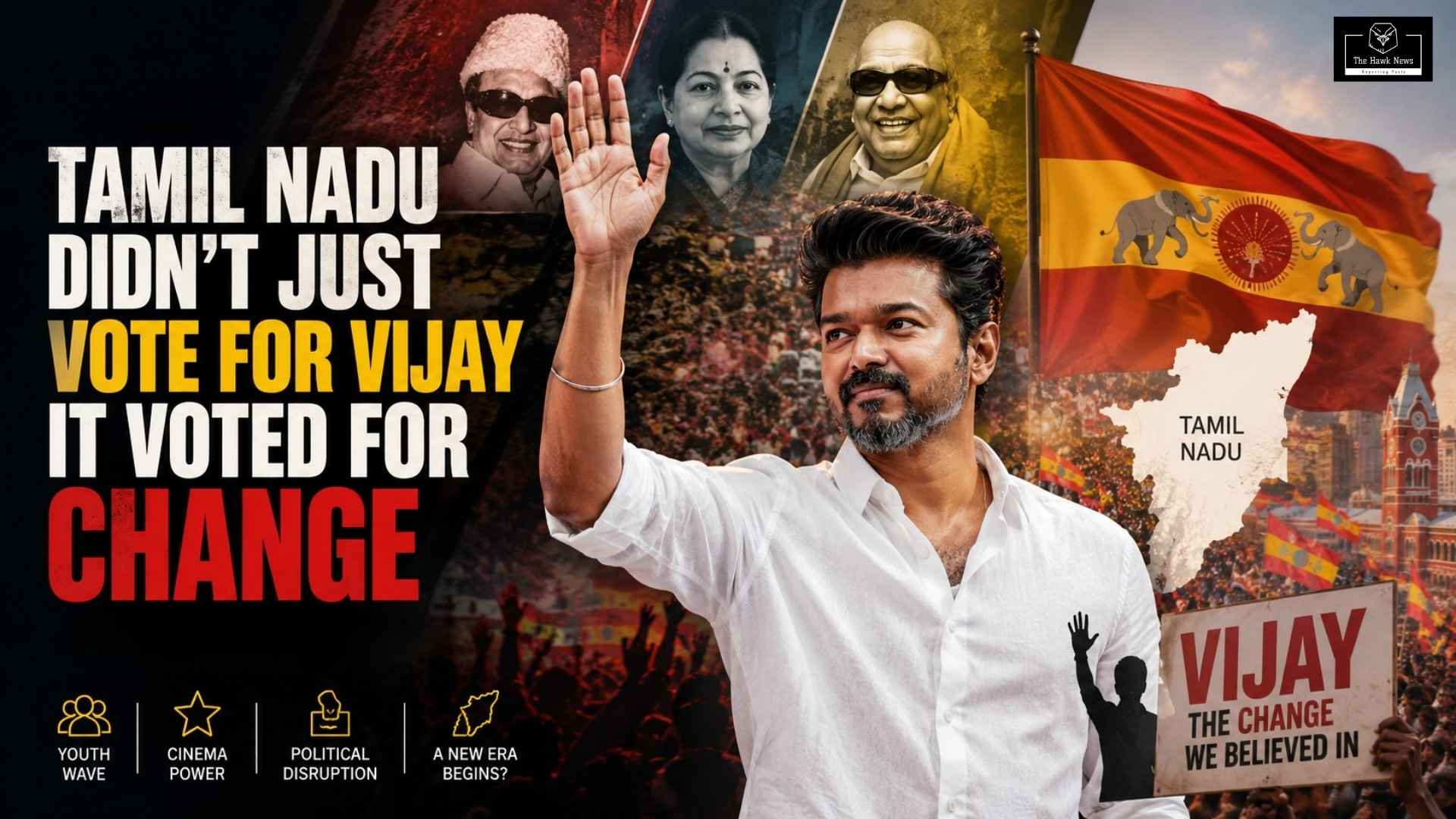
The state moved between two massive poles, the DMK and the AIADMK. Elections were intense, personalities were larger than life, but the structure itself rarely felt fragile. One side carried the ideological legacy of the Dravidian movement. The other carried the emotional inheritance of M. G. Ramachandran and J. Jayalalithaa.
Then came Vijay.
At first, many dismissed his political arrival the same way celebrity political entries are usually dismissed: loud crowds, fan excitement, temporary noise.
But something unusual happened.
The crowds did not disappear.
The conversations deepened.
And experts slowly stopped asking, “Can Vijay matter politically?” and began asking a different question:
“What does Vijay’s rise say about Tamil Nadu itself?”
That question is now at the heart of political discussions across the state.
Because this story may not really be about a film star entering politics.
It may be about a political generation beginning to detach itself from the past.
A State That Was Quietly Changing
Tamil Nadu’s politics has always been emotional.
People here did not merely vote for parties. They often inherited political identity through family memory, social belonging, and cultural attachment. The Dravidian movement shaped not only governance but language, pride, and identity itself.
But after the deaths of M. Karunanidhi and Jayalalithaa, something shifted.
Not suddenly. Quietly.
The emotional anchors that once defined Tamil Nadu politics became less stable. Younger voters grew up without the same personal connection to older political icons. Political language started changing. Social media replaced much of the traditional political ecosystem.
And in that transition, analysts say, a vacuum emerged.
“Nature dislikes a vacuum,” an old saying goes.
Politics dislikes it even more.
Experts believe Vijay entered precisely at that moment.
Not as a continuation of old politics, but as an interruption to it.
Vijay’s Real Strength Was Never Just Cinema
Tamil Nadu has seen actors enter politics before. Some succeeded. Some vanished.
So why are experts treating Vijay differently?
Because, according to political observers, his real strength was not celebrity alone.
It was preparation.
Long before Tamilaga Vettri Kazhagam formally entered the political battlefield, Vijay’s fan networks had already become deeply organized social structures. Welfare activities, blood donation drives, educational support programs, local mobilization- these were not random acts of fandom anymore.
They were becoming political infrastructure.
One analyst described it bluntly:
“Most parties build cadres and then create emotional connection. Vijay already had emotional connection and slowly converted it into cadres.”
That distinction matters enormously in Tamil Nadu politics.
Because elections here are not won only through speeches, they are won booth by booth, street by street, relationship by relationship.
And experts increasingly believe Vijay entered politics with something most newcomers lack:
a pre-built emotional ecosystem.
Cinema Still Matters in Tamil Nadu More Than Outsiders Understand
There is a tendency outside Tamil Nadu to underestimate how deeply cinema and politics are intertwined in the state.
But here, cinema has never been “just entertainment.”
Cinema created mythology.
Cinema created moral heroes.
Cinema created political imagination.
From C. N. Annadurai to MGR, the screen often served as a rehearsal stage for political power.
And Vijay understood that language.
Films like Sarkar carried themes of corruption, political frustration, and systemic anger. Movies such as Leo reinforced his image as someone who confronts powerful systems rather than submits to them.
Experts say audiences do not always distinguish between cinema and public identity.
Especially in Tamil Nadu.
“The political leader arrives long before the politician officially enters,” one Chennai-based commentator recently observed.
In many ways, Vijay’s political image was already being built inside theatres years before campaign stages appeared.
The Youth Didn’t See Vijay as a Politician
This may be one of the most important insights experts keep repeating.
Many younger voters did not experience Vijay the way older generations experienced traditional politicians.
To them, he appeared outside the system.
That perception became powerful.
Across urban Tamil Nadu, especially, younger voters increasingly express frustration toward traditional political structures. Many feel disconnected from ideological battles that shaped earlier generations.
What they respond to now is authenticity, emotional clarity, visibility, and disruption.
Vijay fit that mood almost perfectly.
His speeches were simpler.
His messaging felt direct.
His digital presence was stronger than many traditional parties.
And unlike legacy politicians, he entered politics carrying familiarity instead of institutional distance.
One political observer summarized it sharply:
“Older leaders asked voters to trust history. Vijay asked voters to trust possibility.”
That line captures much of what experts believe happened.
But Excitement and Governance Are Not the Same Thing
Even analysts impressed by Vijay’s rise continue to raise serious concerns.
Politics is one thing. Governance is another.
Campaign energy can electrify crowds. Administration demands endurance, discipline, negotiation, and policy depth.
Several experts have warned that celebrity-driven political movements often face their toughest test after electoral momentum fades.
Questions remain around:
- organizational depth,
- policy consistency,
- administrative preparedness,
- candidate quality,
- and long-term sustainability.
Tamil Nadu’s electorate is politically sophisticated. Emotional momentum may create breakthroughs, but governance performance ultimately decides political survival.
As one analyst bluntly noted:
“Charisma can open the door. It cannot run the state by itself.”
That skepticism matters because it keeps the conversation grounded.
Right now, experts do not view Vijay as a finished political force. They view him as a rapidly evolving one.
The Real Story May Be Bigger Than Vijay Himself
Perhaps the most fascinating part of this political moment is that even critics now acknowledge something fundamental has changed.
For decades, Tamil Nadu politics operated inside a stable binary. Today, that certainty feels weaker.
And that may be Vijay’s biggest political achievement already.
Not necessarily winning power.
But proving disruption is possible.
Experts say his rise reflects several deeper realities:
- Younger voters are moving beyond inherited loyalties,
- personality-driven politics is resurging,
- cinema still holds emotional influence,
- and traditional political structures no longer feel untouchable.
In many ways, Tamil Nadu appears to be entering a new political chapter where identity, media, emotion, and generational change intersect more intensely than before.
History often changes quietly before it changes loudly.
And perhaps that is what experts believe they are witnessing now.
Not merely the rise of an actor.
But the slow rewriting of Tamil Nadu’s political script.
Because in the end, voters may not have simply voted for Vijay.
They may have voted for the feeling that something new was finally possible.