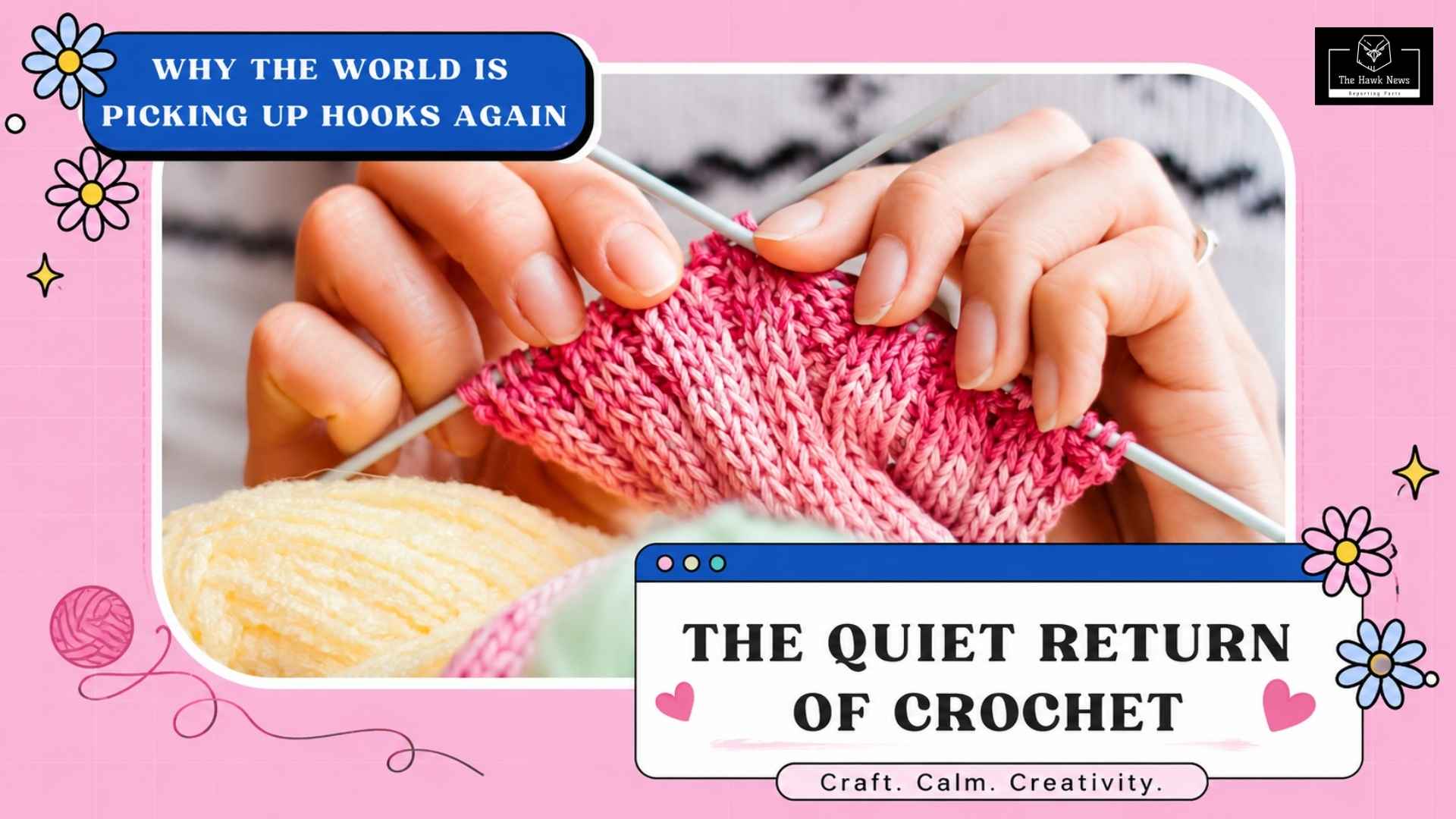
In cafés, college dorms, airports, bookstores, and even corporate lounges, a quiet rhythm has returned to human hands.
Loop. Pull. Twist. Repeat.
Crochet, once seen as an old-fashioned domestic craft tucked away in grandmother’s baskets, has suddenly become one of the most talked-about creative movements in modern culture.
Scroll through social media today, and you’ll find young creators making everything from plush toys and luxury handbags to fashion pieces and intricate wall art, all from a simple hook and yarn.
But crochet’s rise is not merely about aesthetics.
Behind every stitch lies something deeper:
a search for slowness in a fast world.
More Than Just Yarn and Hooks
Crochet is a textile craft where fabric is created using a single hooked needle called a crochet hook. The word itself comes from the French word croche, meaning “hook.”
Unlike knitting, which uses two needles and multiple active loops, crochet works primarily with one active loop at a time. That small difference changes the entire experience.
Knitting often produces soft, uniform fabrics ideal for sweaters and socks. Crochet, meanwhile, creates richer textures, sculptural designs, bold patterns, and artistic freedom. From bohemian fashion to plush “amigurumi” toys inspired by Japanese craft culture, crochet allows imagination to take physical form.
And perhaps that creative freedom explains why the craft has exploded in popularity.
Why Crochet Is Suddenly Everywhere
The modern world has become noisy.
People spend hours every day absorbing endless notifications, scrolling through short videos, and navigating digital overstimulation. Attention spans are shrinking while stress levels continue rising.
Crochet offers the exact opposite experience.
It slows the hands.
It narrows the mind’s focus.
It creates rhythm.
For many people, crochet has become a form of escape from algorithm-driven living. During the global lockdown years, millions turned toward handmade crafts for emotional grounding. Tutorials flooded platforms like YouTube and Instagram, while younger generations discovered something unexpected:
Creating with the hands can calm the mind.
What began as a pandemic hobby quietly evolved into a cultural movement.
The Surprising Effect Crochet Has on the Brain
At first glance, crochet may appear simple. But neurologically, it is remarkably active.
Every stitch involves:
- motor coordination,
- pattern recognition,
- sequencing,
- tension control,
- and memory tracking.
The brain continuously processes rhythm and repetition while the hands execute precise movement. This combination activates areas associated with focus and procedural memory.
Many therapists and researchers now compare repetitive fiber arts to mindfulness practices because of the calming effects they can produce.
As crocheters settle into repetitive motion, breathing often slows naturally. Anxiety reduces. The nervous system shifts into a calmer state.
Some even describe crochet as “meditation with movement.”
A Craft That Exercises Memory
Crochet also functions as a subtle cognitive workout.
Patterns require counting.
Stitches require recall.
Mistakes require problem-solving.
Over time, the brain strengthens its ability to recognize sequences and maintain concentration. For older adults, especially, crafts like crochet may help maintain cognitive engagement and dexterity.
In many ways, crochet resembles playing a musical instrument:
The hands repeat physical actions while the mind tracks invisible structure.
The Emotional Reward of Making Something
Modern life is filled with consumption.
People buy, scroll, discard, and repeat.
Crochet interrupts that cycle.
A ball of yarn slowly transforms into something tangible:
a blanket,
a flower,
a toy,
a scarf,
a memory.
That transformation creates a powerful emotional response. The brain experiences satisfaction from visible progress and completion. In psychological terms, crochet provides small but meaningful dopamine rewards through creation rather than consumption.
That may explain why so many people become emotionally attached to the craft.
As many crocheters jokingly say:
“Just one more row.”
Is Crochet Good for the Body?
In moderation, yes.
Crochet can improve:
- fine motor skills,
- hand-eye coordination,
- finger dexterity,
- and focus.
The repetitive motion also encourages rhythmic movement, which many people find physically relaxing.
However, excessive crocheting can lead to wrist strain, neck tension, and shoulder stiffness if posture is ignored. Long sessions without stretching may create repetitive stress issues similar to typing or gaming.
Experienced crocheters often treat stretching as part of the craft itself.
Crochet Is Secretly Mathematics
Beneath its artistic surface, crochet is deeply mathematical.
Patterns rely on:
- symmetry,
- geometry,
- ratios,
- scaling,
- and repetition.
Every increase or decrease changes the spatial structure. Some advanced crochet techniques even model complex geometric concepts so effectively that mathematicians have used crochet to visualize hyperbolic geometry.
In other words:
Crochet is mathematics disguised as art.
The Rise of Handmade Culture
Another reason crochet has returned is cultural fatigue with mass production.
Machine-made products dominate modern life, yet crochet remains difficult to fully automate. Many crochet items are genuinely handmade, stitch by stitch.
That human labor gives crochet emotional value.
A crocheted bag may take fifteen hours to complete. A plush toy may require days of detailed work. What consumers are buying is not merely yarn; they are buying patience, craftsmanship, and time.
In a disposable culture, handmade work feels personal again.
From Hobby to Business
For some, crochet is therapy.
For others, it is art.
For many, it has become income.
Entire businesses now revolve around:
- handmade fashion,
- custom plush toys,
- online tutorials,
- digital pattern sales,
- and craft workshops.
Social media platforms have helped independent creators transform traditional fiber arts into modern entrepreneurship.
Yet despite the commercial success, many crocheters insist the greatest reward is not profit.
It is peace.
Why Crochet Continues to Endure
Crochet has survived centuries because it fulfills something deeply human.
It teaches patience in a culture obsessed with speed.
It rewards consistency in a world addicted to instant gratification.
It turns a simple thread into meaning.
Perhaps that is why people continue returning to it generation after generation.
One stitch at a time,
crochet reminds the modern world that slowing down is not wasted time.
Sometimes, it is healing.