
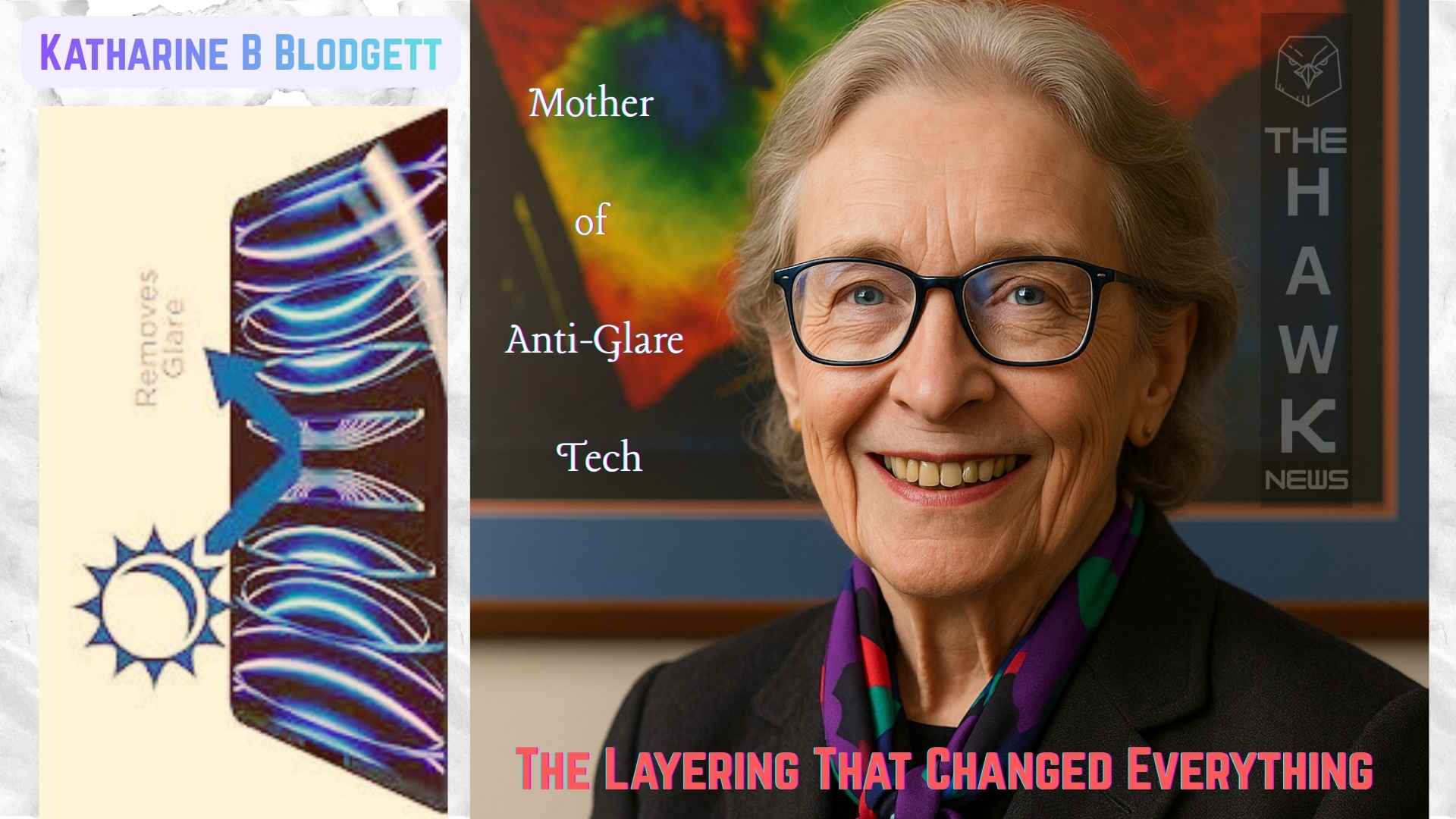

How Katharine Burr Blodgett’s invisible invention became the backbone of our digital lives.
In a world where billions of people stare at screens from dawn to midnight, where photographs, video calls, navigation apps, and digital classrooms rely on crystal clarity, it is astonishing how few know the name of the woman who made it all possible.
Before smartphones, before DSLRs, before high-definition anything, glare was one of science’s most stubborn enemies.
Every glass surface bounced light back at the viewer, washing out images, blurring detail, and making lenses less efficient than they should be.
But in 1938, a woman working mostly behind the scenes at the General Electric laboratory quietly solved the problem — and changed the future of optics forever.
Her name was Katharine Burr Blodgett, and her invention forms the foundation of nearly every lens, every screen, and every piece of optical technology we rely on today.
The Problem She Chose to Solve: Light That Refused to Behave
When Blodgett began her work, the world was still learning how to interact with light.
Telescopes suffered clarity loss.
Microscopes produced foggy results.
Eyeglasses created distracting reflections.
Photographers struggled with unwanted glare.
Light hitting glass always reflected back toward the viewer — up to 4% per surface — which was enough to ruin sharpness and reduce brightness. Scientists had accepted this as an unavoidable truth.
Blodgett did not.
Her question was simple, almost naïve to her male colleagues:
“Can reflection be removed entirely?”
To most in the lab, that sounded impossible.
To her, it sounded like a challenge.
The Layering That Changed Everything
Blodgett collaborated with her mentor, Nobel laureate Irving Langmuir, using microscopic films he had developed. These films were only a few molecules thick — far too thin to be seen with the naked eye.
Blodgett’s breakthrough came when she realized that layering these films with mathematical precision changed the way light interacted with glass.
She learned that if she deposited the film in layers of specific molecular thicknesses, the light waves reflecting off the top layer and the bottom layer would interfere with each other.
Not randomly.
Not partially.
But perfectly.
They cancelled each other out.
This phenomenon — known as destructive interference — created something the world had never seen before:
Glass that didn’t reflect any light at all.
Invisible glass.
Anti-glare glass.
Her first demonstration panel was so non-reflective that photographers complained their cameras couldn’t register the glass piece — it simply disappeared.
It was a technological miracle.
And it was built one invisible molecular layer at a time.
Why She Wanted Anti-Glare: A Purpose Ahead of Her Time
Blodgett didn’t pursue anti-reflective coating for vanity or commercial hype.
She wanted better science.
• Clearer microscope lenses to understand biology.
• Better telescopes to study the stars.
• Sharper photographs for research and documentation.
Her motivation was deeply rooted in precision, in the quest for clearer truth.
She believed science should not lose information to something as basic as glare.
Ironically, that simple pursuit of clarity laid the foundation for the future of digital imaging.
The Technology That Powers the Screen in Your Hand
Fast forward nearly a century, and her invention has become indispensable.
Everywhere optical clarity matters, Blodgett’s work is quietly present:
• Your eyeglasses — anti-glare coating.
• Your smartphone screen — thin-film interference layers.
• Your laptop and TV — reflection control layers.
• Your camera lens — multi-coated surfaces.
• Your VR and AR headsets — advanced anti-reflective films.
• Your microscopes, telescopes, projectors — all built on her logic.
Even today’s multi-layer coatings — sometimes 30 or more layers thick — trace their core principle back to her 1938 molecular films.
Every sharp photograph, every glare-free Zoom call, every bright screen on a sunny day…
they all carry Blodgett’s fingerprint.
A Woman Ahead of Her Time — and Erased by It
Despite her brilliance, her name faded from mainstream history.
She held eight patents, revolutionized materials science, and shaped how our digital world sees itself — yet she was rarely credited in her era simply because she was a woman in physics.
Her invention made glass invisible.
History tried to do the same to her.
But today, as our lives move deeper into digital dependence, it is impossible to ignore the truth:
Katharine Burr Blodgett shaped the modern screen age long before screens even existed.
The Legacy We Live Through Each Day
Modern optical engineering still uses the Langmuir-Blodgett process.
Nanotechnology still applies her principles.
Thin-film science still references her equations.
And every engineer designing a new lens still relies on her discovery.
While tech giants dominate headlines, it’s worth remembering that one of the most important innovations in visual technology — arguably more important than the digital sensor or touchscreen — was created by a young woman working with molecules and math in the 1930s.
She didn’t just remove glare.
She cleared the way for everything that would come after.
Her work turned glass from an obstacle into a gateway.
And in doing so, she opened the world’s eyes.