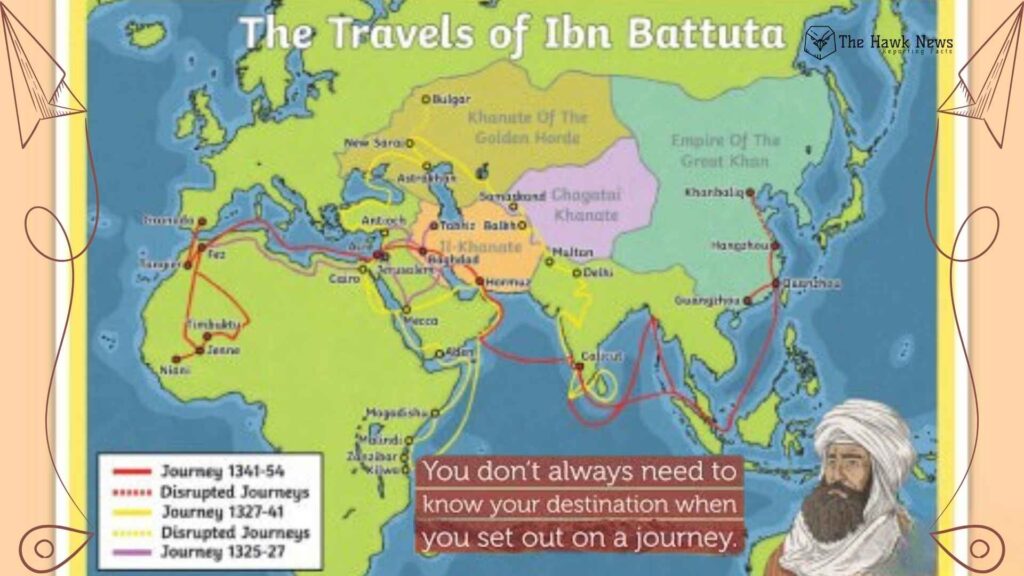
In an age where every journey requires GPS, hotel bookings, backup chargers, insurance, and itinerary PDFs, it’s hard to imagine a person who simply stood up one morning and walked across continents — without knowing where he’d sleep, what language people spoke, or how long it would take to reach the next village.
But in 1325, a 21-year-old Moroccan named Ibn Battuta did exactly that.
He had no map.
No detailed plan.
No certainty of survival.
Just a heart restless for the road — and a willingness to take the first step even when the destination was blurry.
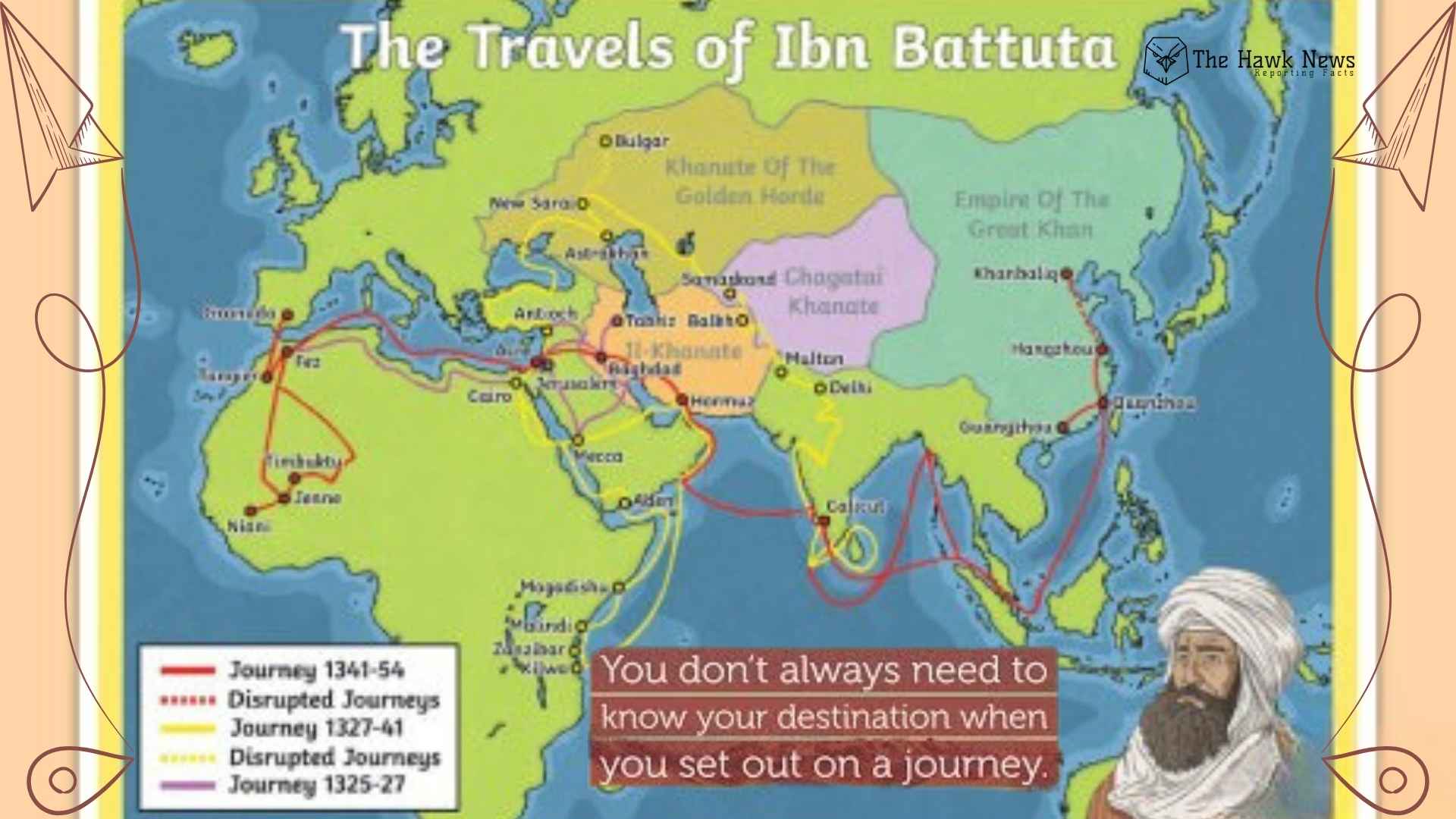
What followed was one of the greatest journeys ever recorded: 75,000 miles, 44 modern countries, and nearly 30 years on the road.
By comparison, Marco Polo travelled less than half that distance — with an army, entourage, and merchant funding. Ibn Battuta? He travelled like a minimalist Gen Z backpacker with a philosophy degree and an instinct for chaos.
And that’s exactly why his story matters now more than ever.
Why Gen Z Connects to Ibn Battuta’s Energy
Gen Z lives in a world overloaded with information:
- Too many choices
- Too many expectations
- Too much pressure to “have it figured out”
- Too much fear of choosing wrong
The result?
A generation that feels stuck before they even begin.
And then comes Ibn Battuta, a man from 700 years ago whispering the exact opposite of modern anxiety:
“You don’t need to know the route.
Start walking. The road makes itself visible.”
He left Morocco to perform the Hajj pilgrimage — a journey meant to end in Mecca.
Instead, he kept walking.
He walked so far he reached:
- Egypt
- Syria
- Iraq
- Persia
- India
- Maldives
- Sri Lanka
- Sumatra
- China
- East Africa
- Anatolia
- And eventually, back home
Every time he reached a place that could have been “the end,” he simply said, “Not yet.”
This is the vantage point:
He shows us that clarity is not a prerequisite for purpose. Clarity is something you discover on the way.
The World’s First “Just Go With It” Traveler
Ibn Battuta wasn’t a warrior, politician, or merchant.
He had no grand goal, no empire to build, no fortune to chase.
His journey feels strangely… modern.
He travelled because he wanted to see what happened if he didn’t turn back.
Imagine that today:
A 21-year-old telling their parents, “I’m travelling for… 30 years. I’ll figure it out.”
Most of us won’t even go on a weekend trip without checking 12 reviews and a weather app.
Ibn Battuta was vibes-only, instinct-driven, motion-powered.
And somehow, this approach led him to:
- Become a judge in India
- Survive pirate attacks
- Escape rebellions
- Marry multiple times across different countries
- Write one of the most important travel chronicles in history
- Reach China long before global tourism was even a concept
Not because he knew the path.
But because he dared to take the first step.
The Route Appears After You Start — Not Before
This is the heart of your chosen vantage point, my fren:
“A Reminder That You Don’t Need to Know the Route to Start the Journey”
Ibn Battuta had no map.
The idea of a globe didn’t exist.
He didn’t even know what China looked like, only that “some travelers said it was far.”
But here is the magic:
Every new person he met became a guide.
Every new road he walked revealed a little more of the world.
Every uncertainty became part of the adventure.
This lesson screams relevance today.
Gen Z faces more pressure than any generation:
- Choose a career early
- Be financially stable
- Have a passion
- Have a side hustle
- Be productive
- Be mentally well
- Make content
- Be perfect
And in all this noise, the simplest truth gets buried:
Movement creates purpose.
Clarity grows from motion, not waiting.
Ibn Battuta walked into the unknown because the unknown didn’t scare him — stagnation did.
What His Journey Teaches a Confused Generation
1. You don’t need a perfect plan — you need courage.
He set out without certainty.
If he waited for clarity, his story wouldn’t exist.
2. Curiosity can carry you farther than experience.
He wasn’t a seasoned traveler; he became one by travelling.
3. The world is more welcoming than you think.
He survived because strangers helped him.
Every city gave him guidance, food, purpose.
4. A wrong turn is still part of the story.
He got lost, robbed, stranded — yet every setback expanded the journey.
5. Your life doesn't need to look linear to be meaningful.
His path was chaotic, messy, unpredictable — but unforgettable.
Gen Z doesn't want the "safe" route.
Gen Z wants the meaningful route.
The Journey That Plant Seeds — Even Centuries Later
When he finally returned to Morocco at age 50 — old, tired, and changed — the Sultan asked him to dictate everything he’d seen.
This became the famous travel chronicle Rihla (“The Journey”), one of the most detailed travel records in medieval history.
Nothing he wrote was planned.
Nothing was scripted.
It was simply the harvest of a life that began without a map.
This is the final message:
You don’t know which steps will shape your life — so start taking them.
Your purpose doesn’t reveal itself in advance.
Your path doesn’t arrive pre-drawn.
Your identity doesn’t come fully formed.
You collect all these things on the way.
The Vantage Point This Generation Needs
Ibn Battuta isn’t just a travel hero.
He’s an antidote to modern paralysis.
He lived the truth that Gen Z is slowly rediscovering:
You don’t need certainty to begin —
you need movement.
Your first step doesn’t need to be brilliant.
It just needs to be taken.
The journey will shape itself.
The road will unfold.
The map will appear under your feet.
Just like it did for the young man who left Morocco with no plan…
…and ended up touching the edge of the world.