
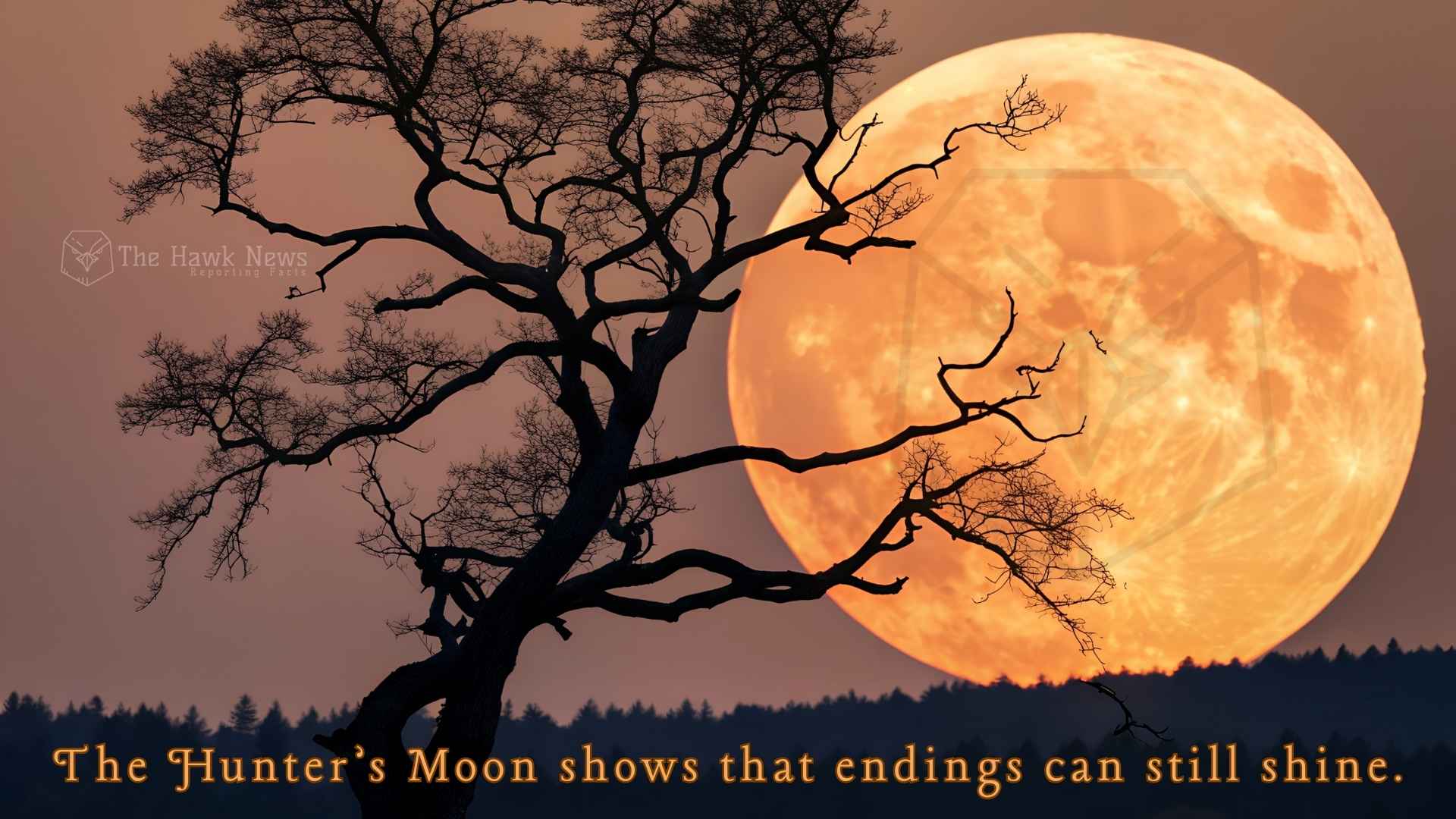
When the Hunter’s Moon rises, it doesn’t merely illuminate the night sky—it lights up the imagination, history, and human spirit.
Known as the first full moon following the Harvest Moon, the Hunter’s Moon has captivated generations, linking modern observers to ancient rhythms of life, survival, and celebration.
Its golden glow seems to hold secrets from the past while inspiring awe in the present, inviting us to pause and reflect under its serene light.
The Origin of the Hunter’s Moon
The Hunter’s Moon is deeply rooted in human history and folklore. The term dates back to at least the 18th century in Europe, but its significance stretches further.
Traditionally, it appeared after the Harvest Moon—the full moon closest to the autumnal equinox. While the Harvest Moon signaled the end of crop-gathering season, the Hunter’s Moon marked a shift: a time to hunt and gather food in preparation for the winter months.
In agricultural societies, the moon’s consistent brightness provided much-needed light for evening hunts and late-night harvests.
Farmers and hunters relied on the extended moonlit hours to prepare for harsh winters, when food would become scarce. Its name, “Hunter’s Moon,” reflects the practical purpose it served—a guide for survival, rather than a mere astronomical curiosity.
The Science Behind Its Glow
The Hunter’s Moon is unique in its appearance and timing. Unlike other full moons that rise roughly 50 minutes later each day, the Hunter’s Moon rises only about 30 minutes later on successive nights.
This effect prolongs the hours of soft, silvery illumination, which historically helped hunters track prey and gather food.
Additionally, the moon often appears larger and more golden when it’s near the horizon—a phenomenon known as the “moon illusion.”
Atmospheric particles scatter shorter wavelengths of light, letting the longer, warmer hues of red and orange dominate. The result is a moon that feels both majestic and intimate, a celestial companion that seems close enough to touch yet distant enough to inspire wonder.
Cultural Significance Across Time and Place
Beyond its practical uses, the Hunter’s Moon has been a source of cultural inspiration. In European folklore, it was associated with change, preparation, and introspection.
Native American tribes also celebrated the moon, integrating it into seasonal calendars that guided hunting, fishing, and community gatherings.
Even in modern times, the Hunter’s Moon continues to influence art, literature, and spiritual reflection. Writers have long used the moon as a symbol of cycles, transformation, and the passage of time.
Its appearance evokes nostalgia, reminding us that even in an age of artificial light, the natural world retains its power to connect, guide, and inspire.
Why the Hunter’s Moon Still Impacts Us
In our contemporary world, where schedules are dictated by screens and artificial lighting, the Hunter’s Moon offers something rare: a pause.
It reminds us of our place in the larger rhythm of life. Astronomers, photographers, and casual observers alike are drawn to it, finding in its glow both beauty and meaning.
Psychologically, witnessing a full moon can invoke awe—a powerful emotion linked to openness, reflection, and even pro-social behavior.
The Hunter’s Moon, in particular, with its golden, low-horizon glow, has a calming and grounding effect, helping us step out of daily routines and reconnect with nature. For some, it sparks creativity; for others, nostalgia; and for many, a quiet sense of wonder.
The Hunter’s Moon Today: A Moment to Connect
For modern humans, the Hunter’s Moon is more than a relic of agricultural necessity—it is a moment of shared experience.
Social media is flooded with photographs of its rise over city skylines, mountains, and oceans. Communities often organize moon-gazing events, inviting people to experience the celestial spectacle together.
Photographers chase its warm light for striking images, while spiritual seekers interpret it as a symbol of guidance and reflection.
Its presence bridges past and present, reminding us that despite technological advances, we are still creatures attuned to the cycles of nature.
A Moon for the Beholder
Ultimately, the Hunter’s Moon is a mirror, reflecting what the beholder brings to it. For some, it is history—an echo of ancestors hunting under the same glow. For others, it is art—a subject for paintings, poems, or photography.
And for many, it is solace—a quiet companion in a noisy world, offering a moment of clarity, inspiration, or connection.
The moon’s universal appeal lies in its duality: it is both scientific and poetic, practical and mystical. It demonstrates that even in an age dominated by artificial light and instant communication, some phenomena retain the power to humble, inspire, and remind us of the larger rhythms of life.
Conclusion
As the Hunter’s Moon rises, it carries with it centuries of meaning. It is a beacon of survival, a symbol of human creativity, and a reminder of our connection to the natural world.
Observing it is more than a visual experience—it is an invitation to reflect on history, culture, and the quiet power of nature.
Its impact endures because it speaks to something timeless in us: the need to look up, to wonder, and to find our place within the universe’s grand cycles.
So the next time the Hunter’s Moon graces the sky, pause. Watch it, photograph it, or simply sit beneath it in quiet contemplation.
For in its glow, the past and present converge, leaving the beholder with a sense of awe, connection, and inspiration.