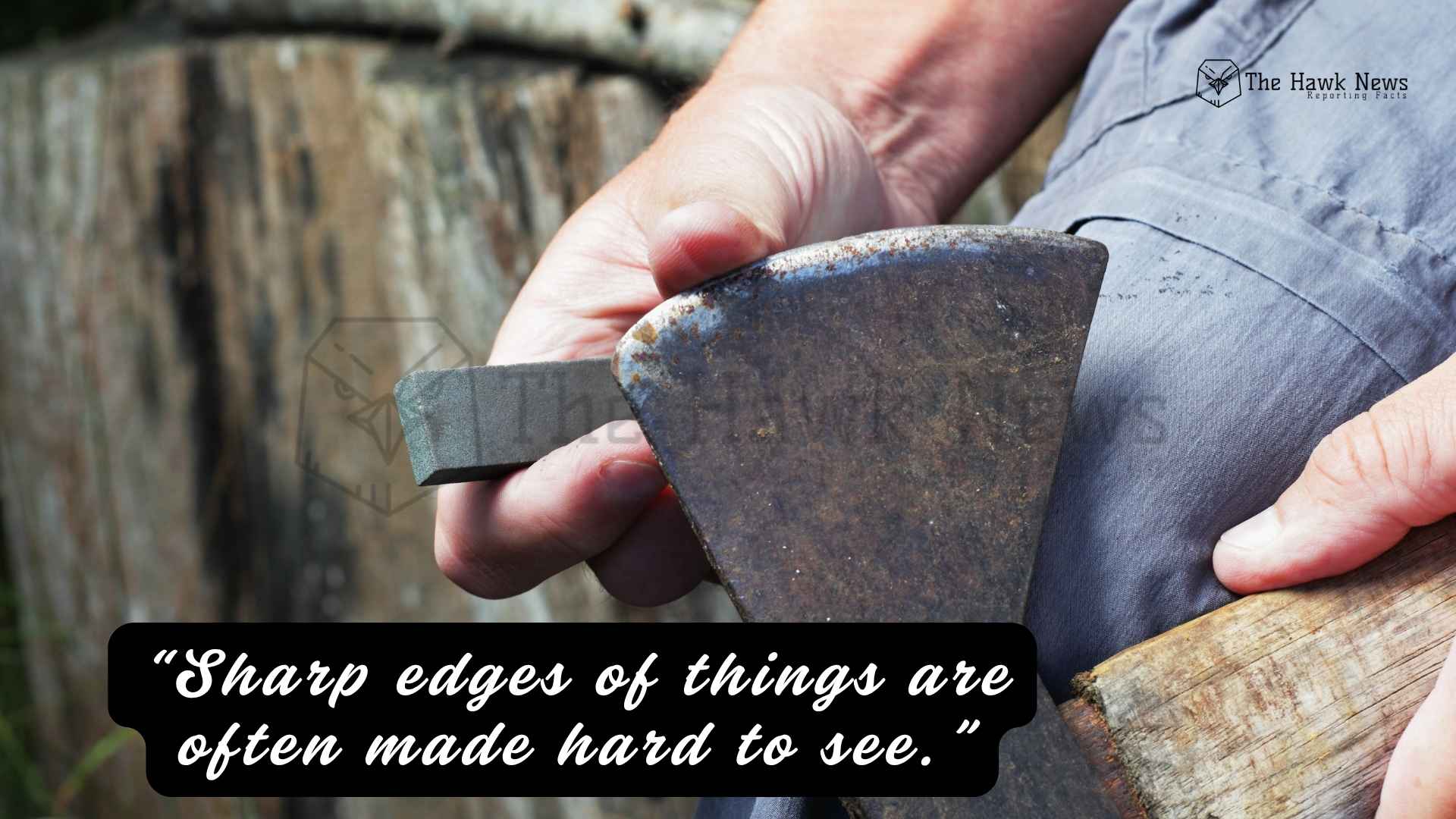

“Sharp edges of things are often made hard to see.”
It’s a line that feels like a whisper — simple, almost unassuming — yet beneath its calm surface lies a truth about the way our world works.
The edges of things, the difficult, the painful, the inconvenient truths — are softened, polished, or hidden altogether.
We’ve built a life that avoids friction, where everything must feel smooth, seamless, easy. But in the process, we’ve begun to lose the very texture of living.
The Comfort of Smooth Surfaces
From the objects we hold to the words we speak, modern life is designed to feel effortless. Phones curve where they once cornered, news is trimmed to fit our attention spans, and even the language of confrontation has been replaced by emoji diplomacy.
The world has learned to sand down its edges — to replace the jolt of truth with the gentleness of convenience.
We prefer what doesn’t cut us. We prefer soft landings, filtered feeds, and endings that don’t sting. But in trading roughness for comfort, we also trade away depth.
When everything feels easy, nothing feels real. When all is smooth, the soul forgets what it means to grasp, to wrestle, to be changed by contact.
The irony is that friction is not the enemy — it’s the evidence of movement, of life brushing against life. The world may market smoothness as progress, but smoothness can also be sedation.
The Disguise of Design
The tendency to hide the edge is not just cultural — it’s deliberate. It’s built into the way we make and sell. Look at the products that surround us. Sleek, minimal, beautifully useless after a while.
Beneath their shine lies fragility — an engineered impermanence that ensures we return for more. It’s what the early 20th century quietly named Planned Obsolescence.
In 1924, the Phoebus Cartel met in Geneva and decided that lightbulbs should no longer burn too brightly or too long. The first bulbs could glow for decades; the new ones would dim at a thousand hours. Longevity wasn’t profitable, so durability became a flaw.
That meeting marked the beginning of a world where the edge of truth — that things could last — was hidden under the guise of innovation.
And so, a pattern began: make it beautiful, make it break, make them come back.
The design of fragility became the design of life. We began to accept disposability as destiny. And soon, what started with objects crept into everything else — attention, art, relationships. We were trained to move on rather than mend.
The Emotional Edge
But the sharpest edges are not in things; they are in us. We hide them under our smiles and distractions. We dull our own inner corners because we fear how they might cut others — or ourselves.
We avoid honest conversations because they bruise. We skip silence because it’s awkward. We turn away from grief because it asks too much of us.
And so, we wrap our hearts in bubble wrap — safe, protected, untouched.
But, a life without edges is a life without shape. Growth comes through abrasion. Honesty is meant to sting before it sets you free.
The truth isn’t meant to be comfortable; it’s meant to be cleansing. The edge refines, just as a blade is sharpened by resistance.
When we make pain invisible, we don’t escape it — we only delay it. The hardest truths we hide eventually return, sharper than before.
The World of Softened Realities
We live inside screens now, where the edges are pixel-smooth. Social media is the art of making everything look gentle, digestible, endlessly appealing.
The mess is cropped out. The flaws are blurred. Even outrage comes packaged neatly for easy scrolling.
But this softening steals something from us — our ability to discern, to feel deeply, to be moved by what’s raw. When we scroll through sanitized versions of reality, we lose our tolerance for what’s real. We forget that discomfort isn’t danger — it’s the beginning of understanding.
Even journalism, bows to this pressure. The edge of truth is often dulled to fit attention spans. Stories are simplified until they lose their sting.
Outrage is rationed into soundbites that spark but never sustain. The world is informed — but seldom transformed.
In this climate, sharpness becomes rebellion. To think deeply, to feel fully, to speak plainly — these are radical acts.
Seeing the Edge Again
To see clearly, we must first be willing to be cut. The sharp edges of things are not meant to wound us, but to wake us. They remind us of consequence, of cost, of care. They teach us that beauty is not always soft, and truth not always sweet.
The real challenge is to live in a world that hides its edges — and still choose to see them. To look at the gloss of progress and ask, What does this convenience cost? To feel discomfort and ask, What is this trying to teach me? To let words, moments, and memories rub against us until they reveal their shape.
Friction is not failure. It’s formation.
The Hidden Blessing of Roughness
The edges of life — loss, rejection, confusion, imperfection — are the chisels that carve our character. Without them, we remain unformed, untested, unfinished.
A smooth stone cannot sparkle. It is the striking, the pressure, the grind that makes it gleam.
When we encounter the roughness of life, our instinct is to file it away. But if we can hold it long enough, we might realize: it’s carving us into something with definition.
Something with presence. Something that can catch the light.
Maybe the world hides its edges because they remind us of our need to grow — and growth cannot be packaged.
A Call to Unblur the World
We cannot change how the world is built, but we can change how we see it. We can train our eyes to notice the subtle manipulations, the softened truths.
We can question the comfort that keeps us small. We can resist the culture that confuses gentleness with avoidance.
The invitation is not to seek pain but to allow clarity. To look again at what has been made invisible — the human labor behind convenience, the emotional cost behind performance, the unspoken tension behind peace.
To see the edge is to see the world as it is — not cruel, but complete.
Closing Reflection
The sharp edges of things are often made hard to see — not because they aren’t there, but because they tell a story we’d rather not hear. But the soul, needs those edges. They teach it how to hold, how to feel, how to endure.
Smoothness may soothe for a while, but it never transforms. The edge, though it cuts, is what gives life its shape.
So, touch the truth. Let it sting if it must. For only when we stop fearing the edge can we begin to see the beauty in its honesty.
The world hides its sharpness to protect our comfort. But comfort never carved anything worth keeping.