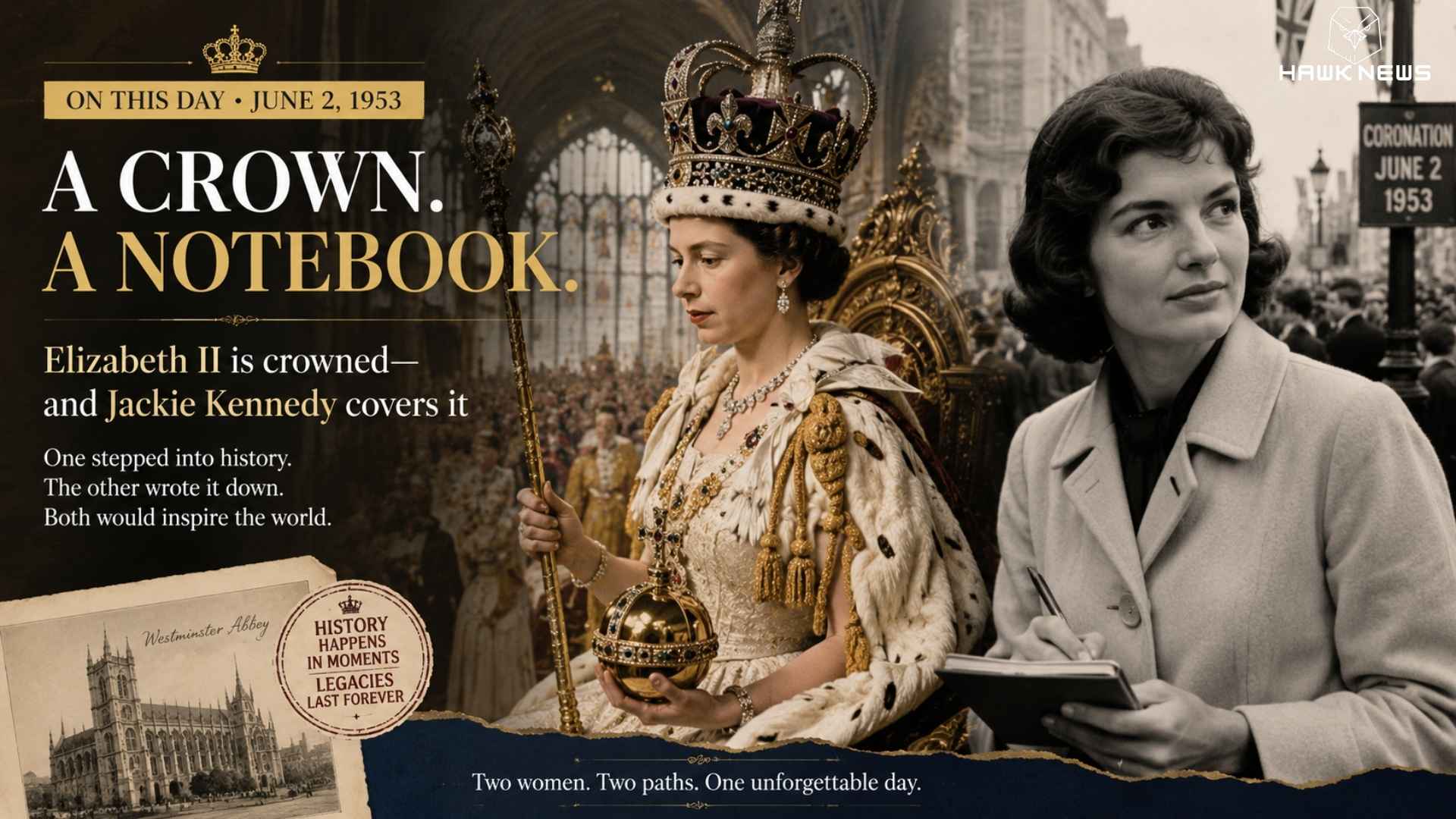
June 2, 1953, was a day of crowns, cameras, and history in the making. Yet hidden within one of the twentieth century's most celebrated ceremonies was a remarkable coincidence: a young queen was ascending the throne while a young journalist stood among the crowd, recording the moment. In time, both women would become global icons.
London awoke beneath gray skies on the morning of June 2, 1953. Rain fell intermittently over streets lined with eager spectators who had camped overnight for a glimpse of history. Flags fluttered from windows. Crowds packed the roads leading to Westminster Abbey. The atmosphere carried a sense of anticipation rarely witnessed in modern times.
Inside the ancient abbey, a 27-year-old monarch prepared for the most significant day of her life.
Across the city, among journalists covering the spectacle, a young American reporter sharpened her observations and prepared to tell the story to readers thousands of miles away.
Neither woman could have known how profoundly history would remember them.
One was about to be crowned queen.
The other would soon become America's most celebrated First Lady.
A Crown for a New Era
When King George VI died in February 1952, his eldest daughter unexpectedly found herself at the center of Britain's future. Though she had already become queen upon her father's death, the coronation was the formal and symbolic moment that would introduce her reign to the world.
Queen Elizabeth II entered Westminster Abbey surrounded by centuries of tradition. The ceremony drew upon rituals that stretched back nearly a thousand years, linking the young monarch to generations of kings and queens who had come before her.
Britain was still recovering from the scars of World War II. Rationing had only recently begun to ease. Cities carried reminders of wartime destruction. Yet the coronation offered something many people desperately needed: hope.
The young queen represented renewal.
She embodied a bridge between an older world and a rapidly emerging new age.
As the Archbishop of Canterbury placed St. Edward's Crown upon her head, millions around the world watched with awe. It was one of the first major international events to be widely televised, bringing the grandeur of Westminster Abbey directly into people's homes.
A new Elizabethan era had begun.
"The crown is not merely a symbol of power. It is a symbol of service."
Few monarchs would come to embody that principle more completely than Elizabeth II, whose reign would eventually become the longest in British history.
The Reporter Among the Crowds
While royal officials, dignitaries, and world leaders took the spotlight, another young woman quietly observed everything.
Her name was Jacqueline Bouvier.
At the time, she was a journalist for the Washington Times-Herald, a newspaper in the United States. Intelligent, poised, and naturally curious, she had earned a reputation for engaging interviews and keen observations.
Unlike many reporters focused solely on official proceedings, Jackie possessed a talent for noticing human details, the emotions of spectators, the atmosphere in the streets, and the stories unfolding beyond the ceremonial grandeur.
As London celebrated, she moved through the crowds, gathering impressions and experiences for her readers back home.
To those around her, she was simply another reporter covering a major international event.
History, however, had larger plans.
Standing at the Threshold of Destiny
One of the most fascinating aspects of history is that people rarely recognize its turning points while they are living through them.
June 2, 1953, was one of those moments.
Elizabeth was stepping into a role that would define her entire life. The responsibilities awaiting her were immense. Few could have imagined that she would remain on the throne for seven decades, guiding the monarchy through extraordinary social, political, and technological change.
Jackie, meanwhile, stood at the edge of her own transformation.
Only a few months after covering the coronation, she would marry John F. Kennedy.
The young journalist would become Jacqueline Kennedy.
Soon afterward, she would become First Lady of the United States and one of the most admired women in the world.
Her elegance, intelligence, cultural influence, and resilience would make her an enduring figure in American history.
On that rainy London day, however, neither future had fully unfolded.
One woman carried the weight of a crown.
The other carried a reporter's notebook.
Two Women, Two Legacies
Though their paths would occasionally intersect in later years, what makes the coronation story so captivating is its simplicity.
History often celebrates dramatic encounters between famous individuals. Yet sometimes its most meaningful connections occur before greatness has fully arrived.
In 1953, Elizabeth II was a young woman assuming an ancient responsibility.
Jackie Bouvier was a young journalist pursuing a promising career.
Neither had yet become the legendary figure the world would come to know.
Yet both possessed qualities that would define their futures: grace under pressure, public composure, and an ability to captivate people far beyond their own nations.
One would become the face of the modern monarchy.
The other would become the face of American elegance and cultural influence.
Together, they would help shape the visual and emotional memory of an era.
A Moment Hidden in Plain Sight
The spectators who lined London's streets on June 2, 1953, believed they were witnessing a coronation.
They were.
But unknowingly, they were also witnessing the convergence of two extraordinary stories.
The cameras focused on the queen inside Westminster Abbey.
Few noticed the young reporter outside.
Yet history would eventually place both women among the most recognizable figures of the twentieth century.
One would reign for seventy years, becoming a symbol of continuity in a changing world.
The other would leave an indelible mark on American culture, politics, and public life.
The Power of Looking Back
There is something profoundly moving about discovering these hidden intersections of history.
They remind us that the future often stands quietly among us, unnoticed.
On a rainy June morning in 1953, a young monarch received a crown while a young journalist recorded the occasion for her newspaper.
Neither could have known that decades later, historians and readers would look back on that day and marvel at the coincidence.
Yet that is the beauty of history.
Sometimes its most fascinating stories are not found at the center of the stage, but in the unexpected meeting of lives destined for greatness.
On June 2, 1953, one woman made history.
Another was there to write about it.
Before long, the world would know them simply as Elizabeth and Jackie, two icons whose legacies would transcend nations, generations, and time itself.