
A Public Road Turned Into a Punishment Ground
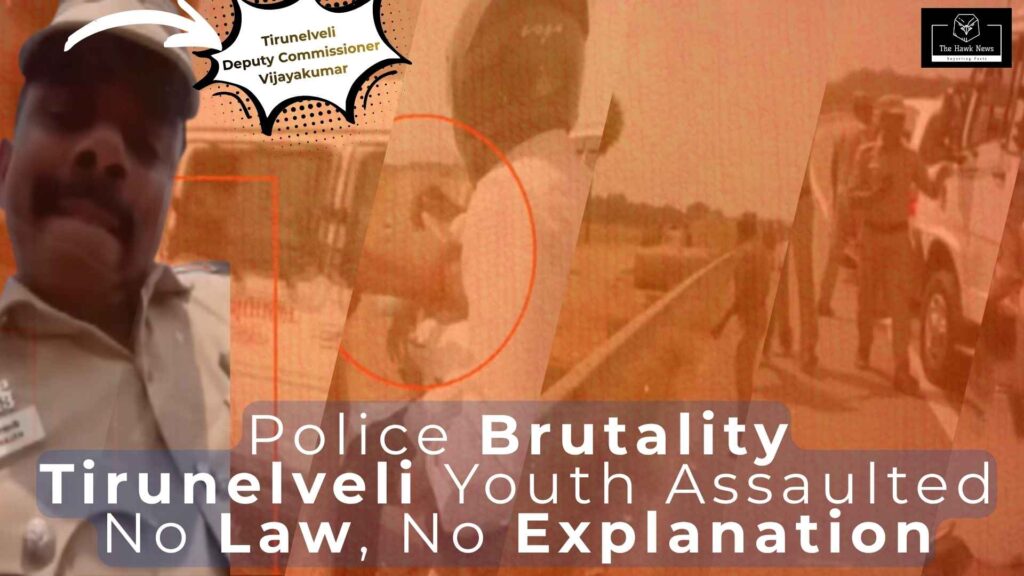
In Tirunelveli, a young motorcyclist riding within traffic norms was abruptly intercepted by a police vehicle without any visible violation or warning. There was no attempt to question, signal, or follow procedure, and the situation escalated instantly into physical confrontation initiated by authority.
Deputy Commissioner Vijayakumar was present at the scene and did not initiate any lawful engagement before acting. Instead of enforcing rules through process, the intervention immediately shifted into physical aggression in full public view.
When Authority Chooses Violence First
The officer stepped out of his vehicle and struck the youth directly in the chest without asking a single question or stating any offence. This act was not reactive but deliberate, removing any space for lawful engagement or procedural restraint from the very beginning.
Another officer immediately followed his lead and began delivering repeated blows with visible intensity and no hesitation. What should have been a controlled situation turned into a rapid escalation driven by those expected to enforce discipline.
From Individual Action to Collective Assault
As the incident unfolded, additional personnel including Rapid Action Force members entered the scene and intensified the situation. The youth’s motorcycle was pushed to the ground, eliminating any possibility of disengagement or movement.
He was dragged to the roadside while multiple officers continued to assault him without pause or control. This was no longer an isolated act but a coordinated display of force carried out collectively.
Questions That Received No Answer
During the assault, the victim repeatedly asked what mistake he had committed and why he was being beaten. These were basic questions that should have triggered explanation or at least momentary restraint from trained officers.
No answer was given at any point, and no officer attempted to justify or even acknowledge his questions. The only response he received was continued physical force delivered without any legal explanation.
A Citizen Forced to Rely on Evidence
Amid the assault, the youth checked whether the incident was being recorded, showing clear awareness of the importance of proof. This reflects a growing reality where citizens rely more on documentation than on institutional response.
Without evidence, incidents like these risk being denied, diluted, or ignored entirely. Recording becomes the only safeguard when systems fail to act on their own.
Procedure Completely Abandoned
Policing follows a defined structure that begins with questioning and moves towards lawful action if required. These steps are designed to ensure that authority is exercised within clear legal boundaries.
In this case, those procedures were completely ignored from the very first moment of contact. Force replaced process, and punishment was delivered without establishing guilt or stating any charge.
Violence Moves Into Public View
Custodial violence has often been associated with spaces hidden from public scrutiny where control over narrative is easier. Such environments allowed delay in accountability and limited immediate reaction.
This incident occurred entirely in public, in front of witnesses, without any attempt at concealment. It signals a shift where such actions are carried out openly without hesitation or fear of immediate consequence.
A Pattern That Refuses to End
Tamil Nadu has witnessed repeated instances of police brutality, with the Sathankulam case remaining a defining example. In that case, custodial torture led to the deaths of Jayaraj and Bennix under extreme conditions.
Public outrage forced legal action, yet incidents like Tirunelveli indicate that deeper systemic correction has not followed. The repetition of such behaviour suggests that lessons from past cases have not translated into change.
Punishment That Does Not Prevent
Severe punishment in earlier cases was expected to act as a deterrent within the system. It was meant to establish clear limits on the use of authority by police personnel.
However, the continuation of similar incidents shows that deterrence has not taken root. The system continues to respond after exposure rather than preventing misuse before it occurs.
Instant Escalation Without Cause
Earlier patterns of misconduct often showed gradual escalation during interrogation or extended custody. There was at least a visible progression before force was applied.
In this case, violence began immediately at the first point of interaction without any transition. There was no suspicion established, no dialogue initiated, and no legal basis presented.
Failure at the Command Level
The involvement of a Deputy Commissioner places this incident beyond the scope of individual misconduct. It reflects a failure at the level of leadership and command responsibility.
When senior officers initiate violence, it creates a precedent that subordinates follow without hesitation. This transforms isolated behaviour into a pattern reinforced by hierarchy.
Authority Replacing Law
The youth was not informed of any violation and was not subjected to any formal legal process. He was stopped and punished instantly without being given an opportunity to respond.
This reflects a system where authority operates independently of law and procedure. Decisions are made on the spot without accountability or transparency.
The Illusion of Control Through Force
Such actions are often justified as necessary to maintain order in public spaces. However, unchecked force does not create discipline or stability within a system.
It replaces structured enforcement with fear, unpredictability, and arbitrary decision-making. Without restraint, control becomes intimidation rather than governance.
Public Trust Continues to Erode
The spread of this incident has triggered strong public reaction and increased scrutiny of policing behaviour. People are questioning not just the act but the system that allows such incidents to occur repeatedly.
There is growing concern about whether internal accountability mechanisms are functioning effectively. There is also rising doubt about whether such actions are being silently tolerated.
Justice That Depends on Visibility
A recurring pattern in such incidents is that accountability follows only when there is clear visual evidence. Without recordings, many cases fail to reach the level of attention required for action.
This creates a system where justice depends on exposure rather than institutional process. It highlights the absence of consistent mechanisms to address misconduct internally.
Fear Moves Away From Law
In a functioning system, fear is directed towards breaking the law and facing consequences. In a failing system, that fear shifts towards those enforcing the law.
The Tirunelveli incident reflects this shift with clarity and concern. The victim feared the officers more than any legal consequence he might have faced.
The Slow Normalisation of Violence
Repeated incidents without consistent correction lead to gradual normalisation within both the system and society. What once triggered outrage begins to be seen as routine behaviour.
This stage represents a deeper institutional crisis beyond isolated failures. When violence becomes expected, accountability becomes optional.
What Tirunelveli Exposes
This incident is not an isolated lapse but part of a broader pattern where enforcement is detached from legality. It exposes a system where power is exercised first and justification is considered later.
It reflects a deeper failure to regulate authority within the structure itself. A system that struggles to control its own use of force.
No Law, No Explanation, Only Force
The events in Tirunelveli reflect exactly what the headline states without exaggeration. A citizen was stopped, assaulted, and left without any explanation for the actions taken.
There was no visible law guiding the conduct of the officers at any stage. Only force was applied, and that remains the most serious indictment of all.