From Stages to Screens
Tamil Nadu’s political campaigns are no longer confined to rallies, banners, and television debates.
A new battlefield has emerged — one that fits inside a smartphone.
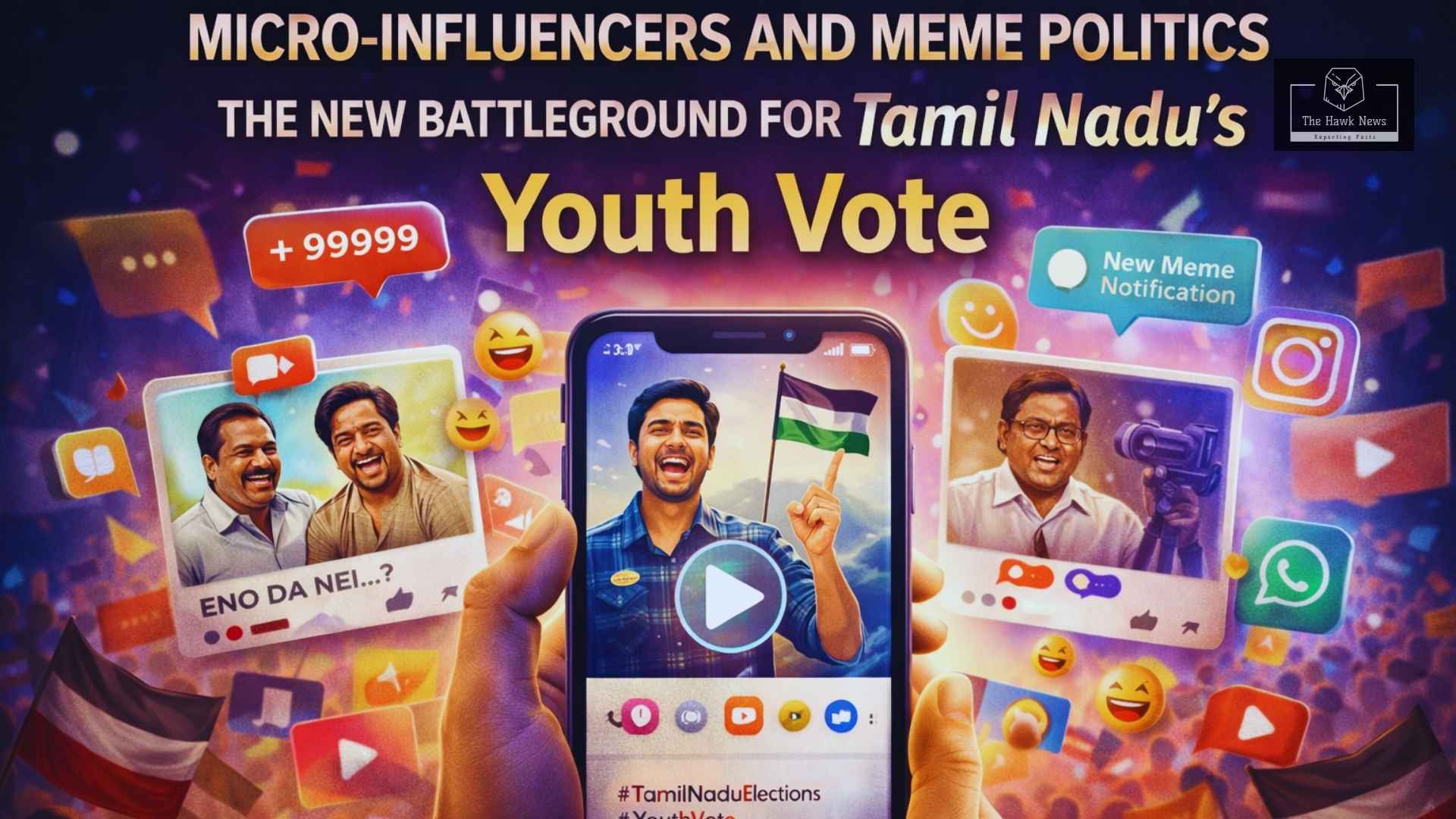
Across platforms like Instagram, YouTube, and WhatsApp, political messaging is increasingly being shaped not just by parties, but by micro-influencers, meme creators, and digital communities.
This is not just a shift in medium — it is a shift in who controls the narrative.
The Rise of Meme-Driven Politics
Tamil Nadu has witnessed a surge in:
- Political meme pages with lakhs of followers
- Local influencers creating short-form political commentary
- Viral reels that simplify complex issues into shareable, digestible content
With India having over 450 million social media users, a significant portion being youth, the digital space has become a primary touchpoint for first-time voters.
For many, political awareness now begins not with a speech — but with a meme.
Why Micro-Influencers Matter
Unlike mainstream political messaging, micro-influencers operate on:
- Relatability over authority
- Speed over structure
- Emotion over detail
Their content often:
- Breaks down political issues into simple narratives
- Uses humor to increase engagement and recall
- Reaches audiences that traditional campaigns struggle to penetrate
A campaign strategist working on digital outreach puts it succinctly:
“You don’t need a rally to reach youth anymore — you need relevance.”
The Strategic Advantage
✔ Pros:
- Massive reach at low cost
- High engagement among 18–30 age group
- Ability to shape narratives organically and rapidly
Political parties, including DMK, BJP, and AIADMK, are increasingly:
- Collaborating with influencers
- Amplifying meme content indirectly
- Monitoring digital sentiment in real time
The Risk Beneath the Virality
However, this new ecosystem comes with serious concerns:
✖ Cons:
- Misinformation spreads faster than fact-checking
- Complex policies get reduced to oversimplified narratives
- Emotional manipulation can overshadow informed decision-making
A digital analyst notes:
“The problem is not reach — it’s accuracy.”
From Narrative to Noise?
One of the biggest challenges is signal vs noise.
While digital platforms democratize voices, they also:
- Blur the line between fact and opinion
- Encourage viral content over verified content
- Reward engagement — not necessarily truth
This creates an environment where:
The loudest message often wins — not the most accurate one.
Ground Reality Check
Despite the rise of digital influence, on-ground realities still matter:
- Family voting patterns remain strong
- Local leaders and candidates continue to influence decisions
- Rural voters rely less on digital narratives
This means meme politics is powerful — but not absolute.
The Youth Factor
Tamil Nadu’s youth electorate is growing — and evolving.
First-time voters:
- Consume politics through short-form content
- Engage through comments, shares, and reactions
- Are influenced by peer-driven narratives
For them, politics is no longer distant — it is interactive and immediate.
The Strategic Dilemma
Political parties now face a critical balance:
- Embrace digital influencers → gain reach
- Control messaging → maintain credibility
Too much control risks losing authenticity.
Too little control risks losing accuracy.
The Bigger Picture
The rise of micro-influencers signals a deeper transformation:
Politics is no longer just communicated — it is performed, shared, and remixed.
The Final Word
The next election may not be decided only at polling booths — but in comment sections, reels, and viral posts.
But the real question remains:
Will voters engage deeper — or just scroll past the truth?