A Promise That Crosses a Line
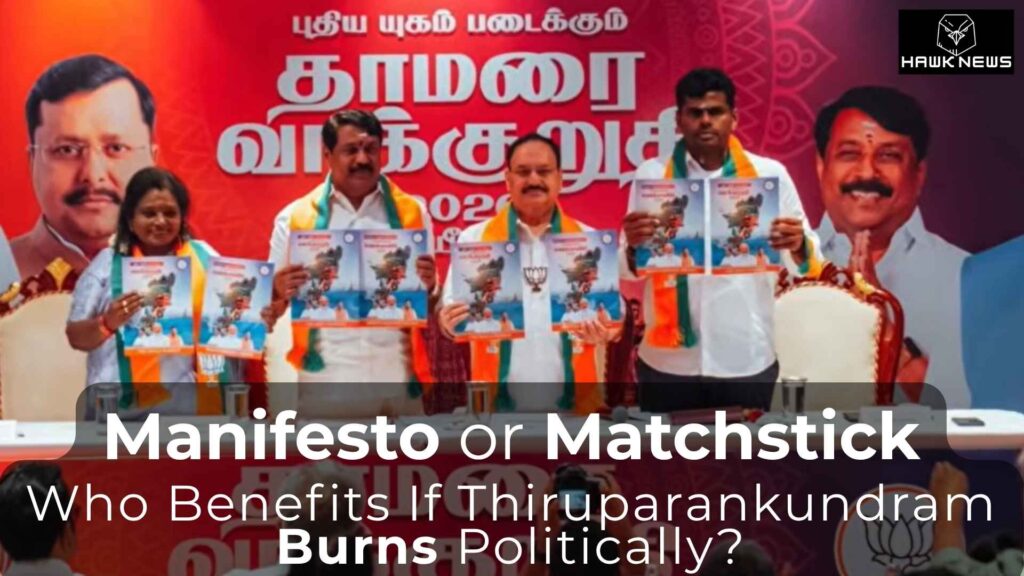
The Bharatiya Janata Party has placed the Thiruparankundram lamp issue inside its Tamil Nadu election manifesto. This is not a routine promise about infrastructure or welfare. This is a live religious dispute, now officially turned into a campaign tool.
When a political party chooses to step into an unresolved, sensitive issue and present it as an electoral commitment, it is no longer governance. It becomes a calculated intervention into a fault line that is already under strain.
Not Just a Temple Ritual
Thiruparankundram is not an ordinary hill. It is one of the sacred abodes of Lord Murugan, carrying deep cultural and spiritual significance across Tamil Nadu.
At the centre of the controversy is the Karthigai Deepam lamp lighting at the hilltop. What appears as a ritual on the surface has now evolved into a layered conflict involving law, administration, and identity.
A Dispute Already in Motion
This issue did not emerge during elections. It has been unfolding over time, involving court proceedings, administrative decisions, and rising tensions on the ground.
The judiciary has intervened, permissions have been debated, and concerns over public order have been repeatedly raised. This is not a dormant issue waiting for political attention. It is an active conflict already under pressure.
Court Orders vs Government Resistance
The legal system has examined the matter and allowed the lighting of the ceremonial lamp. The judgment indicated that speculative fears cannot indefinitely block religious practices.
However, the state government resisted implementation, citing law and order risks. The administration argued that the situation on the ground could escalate if the ritual proceeds.
From Governance Issue to Political Weapon
What was earlier a legal and administrative dilemma has now been repositioned as an electoral promise. The BJP has not merely acknowledged the issue, it has claimed ownership over it.
By stating that it will ensure the lighting of the lamp, the party has transformed a dispute into a political commitment. This shift is not accidental. It is strategic.
The Ayodhya Shadow
The comparison is inevitable. When a religious dispute is elevated into a central political narrative, memories of the Ayodhya dispute come into focus.
That conflict began as a localised issue and eventually reshaped national politics. The question now is whether Thiruparankundram is being positioned along a similar trajectory, deliberately or otherwise.
Emotional Mobilisation Over Policy
Election manifestos are expected to prioritise governance, economy, and public welfare. But here, the spotlight is on a symbolic and emotionally charged issue.
This is not about roads, jobs, or development metrics. This is about identity, belief, and sentiment. And such issues do not remain contained. They expand, often unpredictably.
The Political Calculation
The move appears designed to consolidate a specific voter base. By framing the issue as one of religious rights, it creates a clear emotional alignment.
At the same time, it places opponents in a difficult position. Any resistance can be portrayed as opposition to faith, while compliance risks conceding ideological ground.
The Pressure on the State
The state government now finds itself cornered. It must balance court directives, administrative responsibility, and political optics simultaneously.
If it allows the ritual, it may be seen as yielding to political pressure. If it resists, it risks being labelled as obstructing religious practices. This is not a policy debate anymore. It is a political trap.
A Manufactured Flashpoint?
There is a difference between addressing an issue and amplifying it. Bringing a sensitive dispute into an election manifesto does not resolve it. It intensifies it.
The timing raises concerns. Why elevate this now, when elections are approaching? Why convert an ongoing issue into a central campaign narrative?
Democracy and Responsibility
In a democratic system, leadership carries the responsibility of maintaining stability. Sensitive matters require careful handling, not public escalation.
Turning a contested religious issue into a campaign promise risks sending the opposite message. It signals that political gain may be prioritised over social balance.
Beyond a Single Location
This is not just about Thiruparankundram. It is about the precedent being set. If one dispute can be politicised, others can follow.
Once the line between governance and mobilisation blurs, the consequences extend far beyond a single hill or a single ritual. It begins to reshape the political culture itself.
The Risk of Polarisation
Religious issues, once politicised, rarely remain neutral. They create divisions, sharpen identities, and push communities into opposing corners.
Tamil Nadu has historically maintained a distinct political identity, rooted in social justice and rational discourse. Introducing high-voltage religious mobilisation challenges that balance.
What Is Really Being Lit?
The question is no longer about a lamp. It is about what that lamp represents in the current context.
Is it a symbol of faith being restored, or a spark being introduced into a sensitive environment? The answer depends on how the situation unfolds from here.
The Larger Question
At its core, this issue forces a fundamental question about political intent. Is the goal to resolve a dispute through governance, or to leverage it for electoral advantage?
Because the method chosen matters as much as the outcome. And when the method involves amplifying tensions, the cost is often paid by society, not politics.
Conclusion: Fire or Responsibility
The manifesto has drawn a clear line. It has taken a side in an ongoing dispute and turned it into a promise.
But promises made in elections do not exist in isolation. They carry consequences, especially when they touch upon sensitive fault lines.
So the question remains.
Is this a step towards resolution, or the striking of a matchstick in a politically charged atmosphere?