A Campaign That Speaks — But Not Clearly
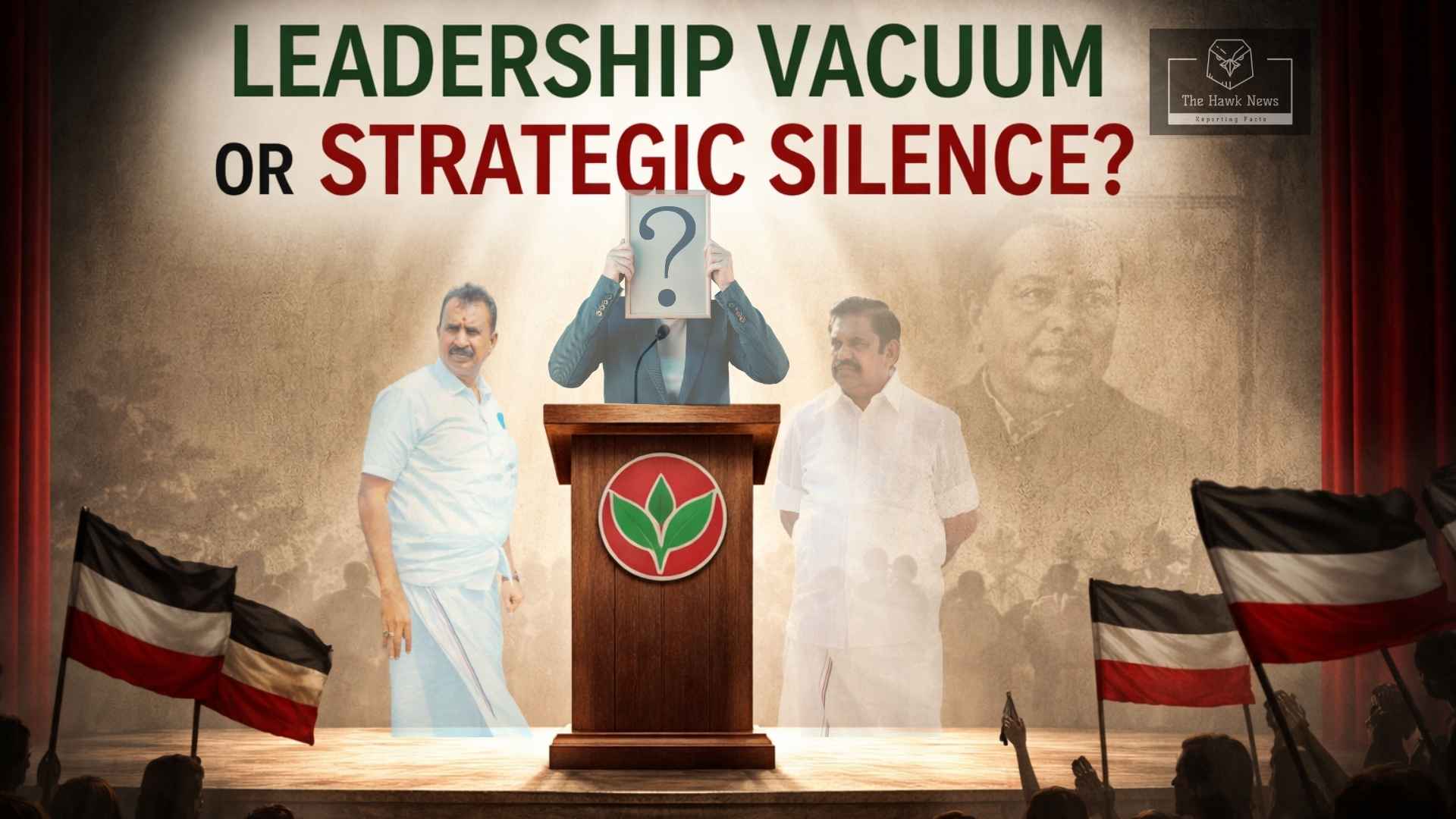
As Tamil Nadu’s political landscape begins to heat up, one question continues to surface:
What exactly is the AIADMK’s core message to voters?
While rivals like the DMK push governance continuity and the BJP experiments with targeted outreach strategies, AIADMK’s campaign appears muted, cautious, and at times, inconsistent.
The result is not silence — but unclear communication.
Reading the Ground Signals
Recent political activity suggests a pattern:
- Limited high-impact statewide messaging
- Absence of a singular, defining campaign narrative
- Sporadic responses to rival attacks rather than proactive positioning
- Mixed signals on alliances and long-term strategy
This has led to a growing perception among observers that AIADMK is reacting more than leading its campaign.
The Leadership Question
AIADMK’s current positioning cannot be viewed without acknowledging its post-leadership transition phase.
Since the passing of J. Jayalalithaa, the party has undergone:
- Internal realignments
- Leadership contests
- Structural recalibration
While it continues to retain a core support base, the challenge lies in projecting a unified and decisive leadership image to a broader electorate.
Why Narrative Clarity Matters
In modern elections, messaging is not just communication — it is strategy.
A clear narrative helps:
- Define the party’s identity
- Offer voters a distinct alternative
- Build momentum and recall
Without it, campaigns risk becoming:
Visible — but not memorable.
What Political Observers Are Saying
Election watchers and campaign analysts often describe the current phase in cautious terms:
“AIADMK is still searching for its central message.”
Another strategist notes:
“The party has strength on the ground, but it needs clarity at the top.”
A third observer frames it more directly:
“In elections, ambiguity rarely converts into votes.”
Strategic Silence — A Calculated Move?
However, not all interpretations are critical.
Some within political circles suggest that AIADMK’s approach may be intentional:
- Avoiding early commitments
- Keeping alliance options open
- Reducing exposure to political attacks
✔ Potential Advantages:
- Flexibility in decision-making
- Lower risk of controversy
- Ability to adapt messaging closer to elections
✖ Potential Risks:
- Perception of indecision
- Loss of narrative control
- Weak connect with undecided voters
Ground Reality Check
Despite messaging concerns, AIADMK continues to hold:
- A significant vote base
- Strong presence in multiple districts
- Residual goodwill from past governance
But elections are not won on legacy alone.
They require:
Clarity, consistency, and conviction in communication.
The Risk of Being Outpaced
As rivals sharpen their narratives:
- DMK emphasizes governance continuity
- BJP leverages digital and targeted outreach
…the absence of a strong counter-narrative could leave AIADMK struggling to define the electoral conversation.
In modern campaigns, perception often moves faster than organization.
The Larger Political Question
This brings us to the core issue:
Is AIADMK’s silence strategic — or symptomatic?
Because in politics, there is a fine line between:
- Waiting for the right moment
- Missing the right moment
The Road Ahead
For AIADMK, the path forward is clear:
- Define a cohesive campaign narrative
- Project decisive leadership
- Translate organizational strength into clear voter messaging
Without this, the party risks:
Being present in the election — but not central to it.
The Final Word
Elections are not just about who has support — but who communicates it effectively.
AIADMK may still hold the numbers.
But unless it finds its voice,
it risks being heard less — in an election where clarity could decide everything.