A Time When Politics Meant Thinking
There was a time in Tamil Nadu when politics did not begin with slogans.
It began with questions.
Not in television studios.
Not on social media timelines.
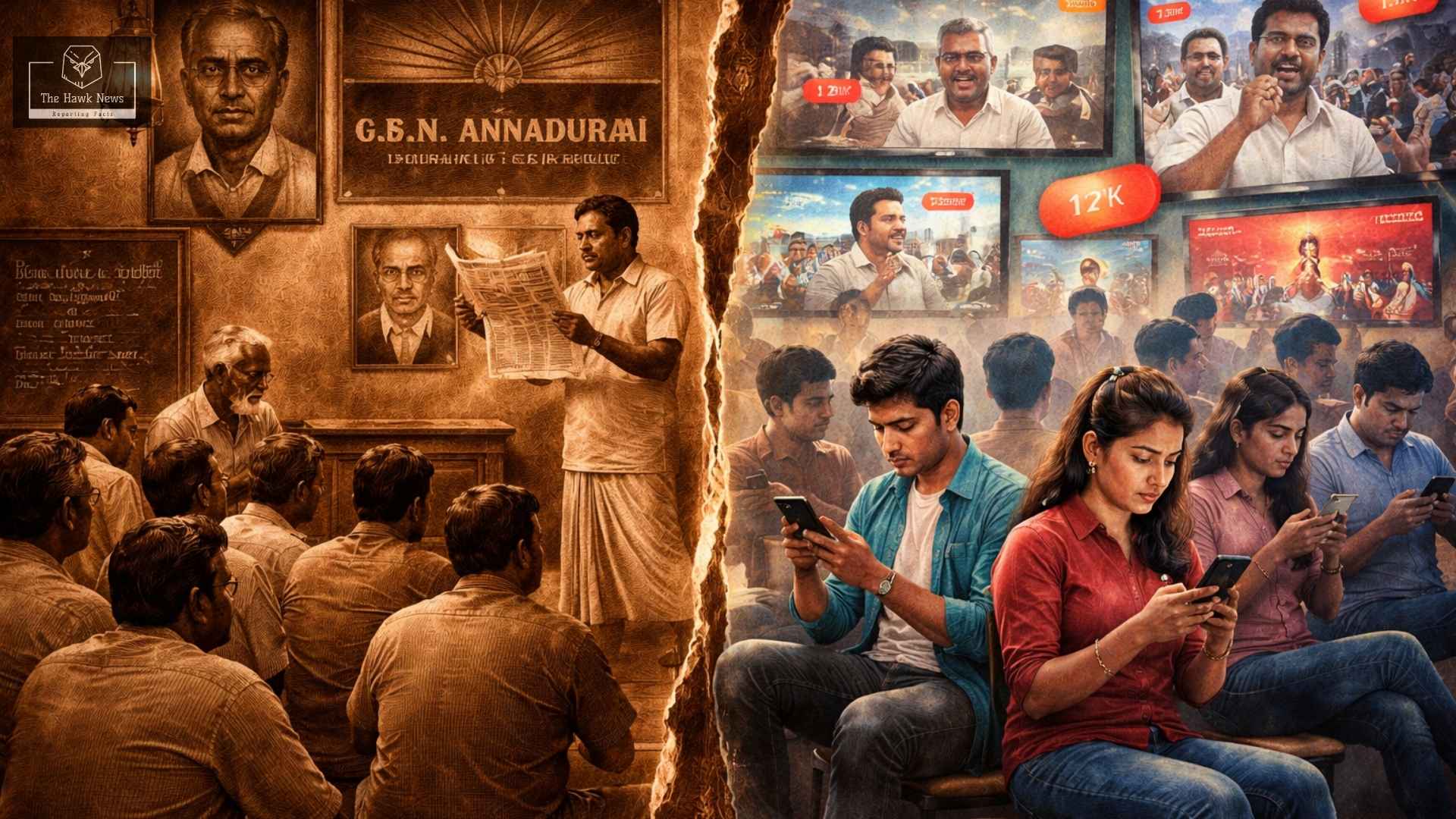
But in small, crowded reading rooms — where ideas were not broadcast, but discussed.
In these modest spaces, the foundations of the Dravidian movement were laid — not through spectacle, but through understanding.
The Quiet Revolution That Changed Power
In the decades leading up to 1967, leaders like C. N. Annadurai faced a challenge that would define their strategy:
How do you take complex political ideas to a society where many cannot yet read?
The answer was simple — and revolutionary.
Create spaces where people could learn together.
Thus began the rise of:
- Reading rooms
- Public discussions
- Shared political learning
One person would read aloud.
Many would listen.
And then — they would question.
When Awareness Became Power
These reading rooms were not passive spaces.
They were:
- Training grounds for political cadres
- Forums for debate
- Classrooms without walls
They gave people something rare in politics:
The ability to understand — before they were asked to choose.
And that understanding changed everything.
In 1967, when a common man defeated a feudal elite in his own stronghold, it was not just an electoral upset.
It was proof that:
An informed society can challenge entrenched power.
Language, Identity, and Confidence
At the heart of this transformation was Tamil.
Not just as a language — but as a tool of empowerment.
People were encouraged to:
- Speak in their own words
- Express their own realities
- Question authority in their own voice
Politics became:
Something people participated in — not something done to them
Then and Now: A Shift in Political Culture
But decades later, the landscape appears to have shifted.
The spaces where politics once unfolded — slowly, thoughtfully — have been replaced.
Today:
- Reading rooms have become scrolling screens
- Debates have become viral reactions
- Political learning has become political consumption
Information is everywhere.
But understanding?
That is less certain.
From Discussion to Domination
Modern political engagement often prioritizes:
- Speed over depth
- Emotion over analysis
- Reach over accuracy
The question is no longer:
“What does this idea mean?”
But often:
“Who is winning this narrative?”
In this environment, politics risks becoming:
- Less about ideas
- More about impact and influence
The New Political Ecosystem
This is not to dismiss the present.
Digital platforms have:
- Expanded access
- Amplified voices
- Increased participation
But they have also created a paradox:
More information — but not always more clarity
Where once a group gathered to understand a newspaper…
Now individuals scroll — often alone — through competing narratives.
What Changed?
The shift is subtle, but significant.
Earlier:
- Politics built collective understanding
Now:
- Politics often builds individual reactions
Earlier:
- Cadres were trained to explain ideas
Now:
- Messaging is designed to win attention
The Question We Must Ask
This is not about nostalgia.
Nor is it about dismissing modern politics.
It is about asking a deeper question:
Are we still building thinking citizens — or just responsive audiences?
Because the answer to that question will shape not just elections —
but the future of democratic engagement itself.
The Lesson from the Past
The architects of Tamil Nadu’s political rise understood something fundamental:
Power gained without awareness is temporary.
Awareness built over time is lasting.
They invested in:
- Minds
- Conversations
- Shared understanding
They believed that:
An informed voter is not just a participant — but a force
The Final Word: A Quiet Warning
Today, politics moves faster than ever.
But in that speed, something risks being lost.
When the focus shifts entirely to:
- Defeating opponents
- Controlling narratives
- Maximizing reach
…the deeper purpose of politics begins to fade.
If politics stops enlightening minds, it begins narrowing them.
The reading rooms of the past asked people to think.
The platforms of today ask people to react.
And somewhere between thinking and reacting lies the future of democracy.
The Last Question
What will we leave behind?
A generation that:
- Engages deeply
- Questions meaningfully
- Understands before choosing
Or one that:
- Consumes quickly
- Reacts instantly
- Moves on just as fast
Before winning votes, the past built minds.
If that changes, the cost may not be immediate — but it will be enduring.