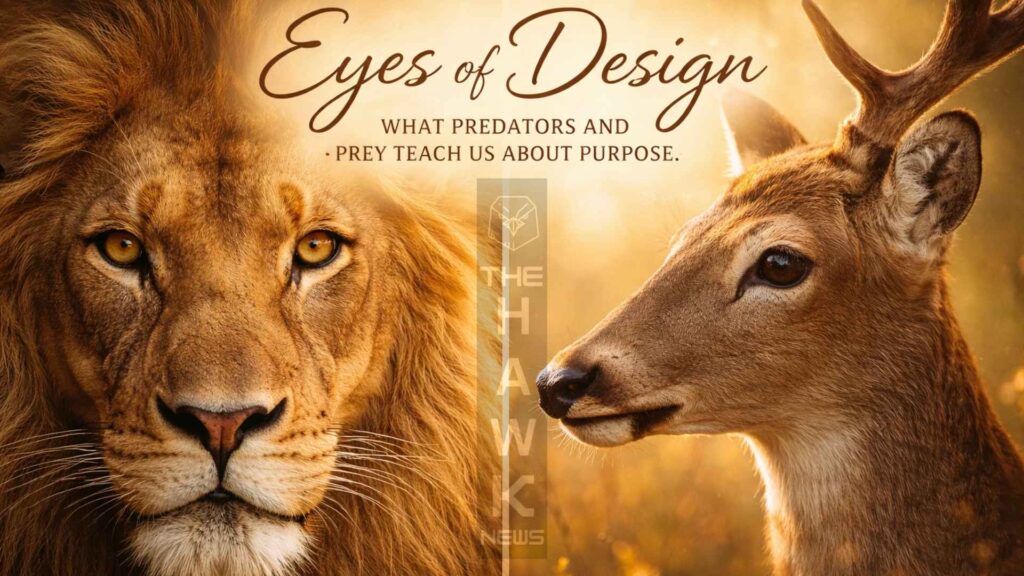
In the silent gaze of the lion and the cautious glance of the deer lies a profound truth.
Vision itself is a message from the Creator, tailored to purpose, balanced in design.
The Language of Sight
Every creature sees the world differently not by chance, but by calling.
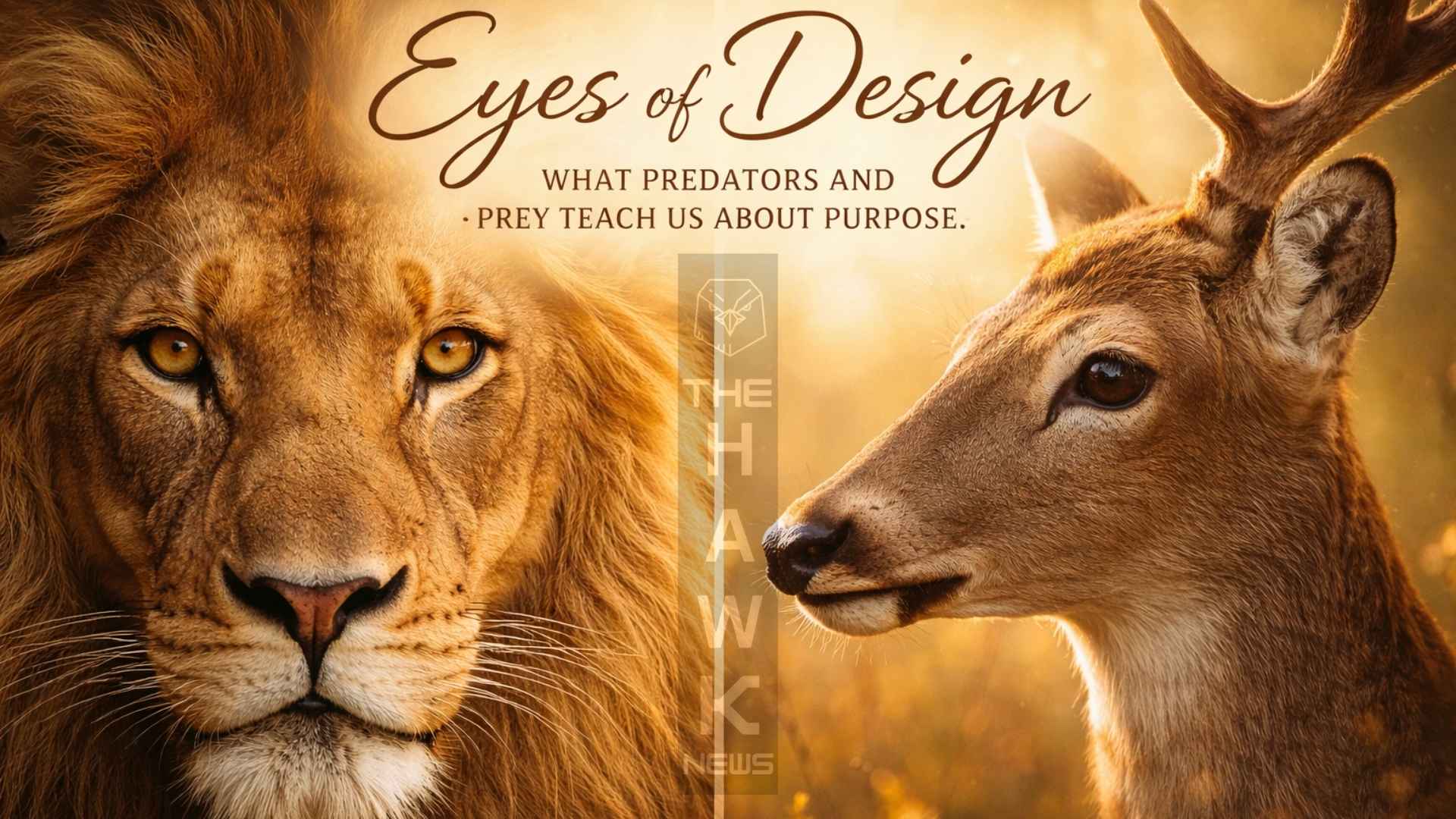
Look closely at the eyes of a predator: they face forward, sharp and sure, locked upon their target.
Now look at the eyes of the prey: wide apart, ever watchful, scanning the horizon for danger.
What seems like mere anatomy is actually divine architecture a design that speaks.
The way a creature looks at the world tells the story of why it exists within it.
“The eyes are not just windows to the soul they are blueprints of purpose.”
Editorial reflection, The Hawk News
The Predator’s Vision/Focus and Foresight
Lions, tigers, eagles, wolves — their eyes face forward.
Both eyes fix on the same direction, granting binocular vision — the gift of depth, focus, and precision.
This design gives predators their edge: the ability to track, chase, and judge distance with deadly accuracy.
It’s not cruelty; it’s clarity.
They were made to move with purpose, to see one thing and pursue it wholly.
In this design, there’s a lesson for the human spirit too:
The power of focus — to fix your gaze on what truly matters and move with intent.
“Predators don’t waste sight on the unnecessary — they look, lock, and leap.”
In life, that’s the vision of purpose.
Not restless movement, but directed pursuit.
Eyes forward — heart steady.
The Prey’s Vision — Awareness and Grace
Then there are the deer, the rabbits, the horses, the goats.
Their eyes sit on the sides of their heads, granting almost panoramic vision — over 300 degrees of awareness.
They can’t focus deeply, but they can sense danger early.
Their design is not for attack, but for alertness; not for dominance, but for survival.
That’s the wisdom of humility — to be aware of the world around you, to see the unseen, to live with vigilance rather than vanity.
Where the predator has precision, the prey has perspective.
“The humble see what the proud overlook.”
— Old shepherd’s saying
Their gift is not aggression, but attentiveness — a quiet watchfulness that preserves life and warns others.
It’s the vision of community, not conquest.
The Divine Balance
Two designs. One wisdom.
The forward eyes of the predator and the side eyes of the prey balance creation itself.
One represents focus, the other awareness.
One hunts for strength, the other watches for safety.
Together, they keep the circle of life in motion.
You see, — it’s not about superiority. It’s about symmetry.
If all eyes faced forward, the world would collapse into conflict.
If all eyes faced sideways, the world would lose its drive.
“The lion and the lamb are both necessary — one for courage, the other for compassion.”
— Proverb of old Africa
And that’s the Creator’s poetry — balance through difference.
Even the eyes were placed in harmony, so the world could breathe evenly between predator and prey.
Reflection: The Vision Within
Every human being carries traces of both designs.
There are moments we must see like the predator — focused, fierce, fearless in pursuit of calling.
And there are moments we must see like the prey — cautious, perceptive, humble enough to sense danger before it arrives.
Faith, too, teaches this balance.
Forward eyes for purpose.
Side eyes for wisdom.
Both guided by the heart — the true compass behind the gaze.
“The Creator placed the eyes where they could best serve the heart.”
— Editorial reflection, The Hawk News
So when you look at the world, ask yourself:
Are you seeing narrowly or widely?
Are you chasing or cherishing?
For both visions are divine — and both are needed to truly see.