A Structural Shift Disguised as Reform
India is entering a phase where structural changes are being framed as administrative necessity. Delimitation, women’s reservation, and One Nation One Election are presented as reforms, but together they signal a deeper redesign of political power.
The concern is not about reform itself, but about the direction of change. When multiple structural shifts align at once, the outcome is not adjustment, it is transformation.
April 16: The Beginning of a Redesign
The decision to move forward with delimitation discussions in Parliament on April 16, 2026 is not a routine legislative step. It marks the beginning of a process that could permanently alter how representation is distributed across India.
Timing matters in democracy. When such decisions are initiated during active political cycles in key states, questions arise about intent, consultation, and fairness of process.
What Delimitation Really Means
Delimitation is often explained as a technical recalibration based on population. But in reality, it is the redistribution of political weight between regions.
Under the freeze introduced by the 42nd Amendment of the Indian Constitution, states that controlled population were protected from losing representation. That protection is now being reconsidered.
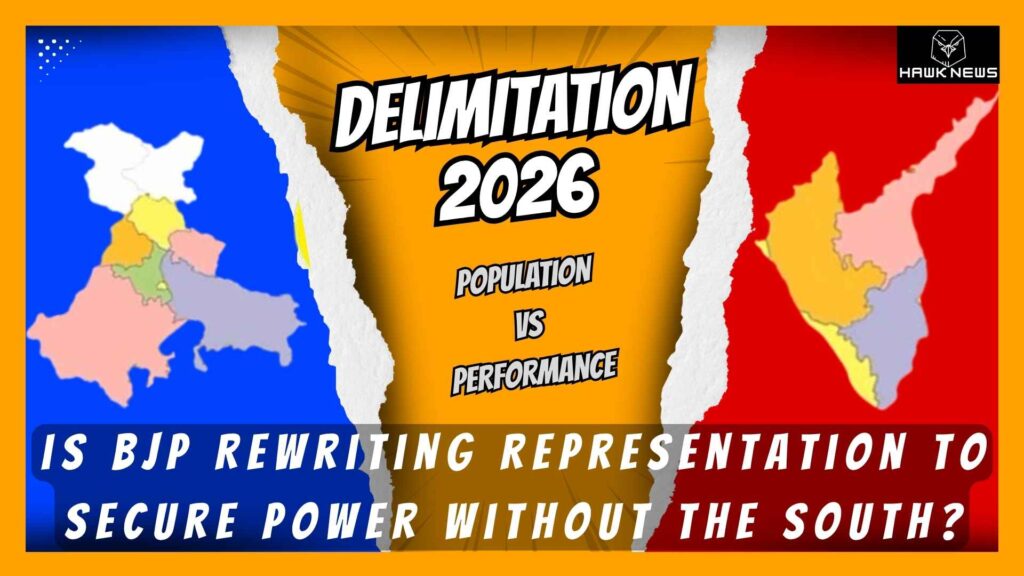
Population vs Performance
The core conflict lies in what India chooses to reward. Southern states focused on literacy, healthcare, and industrial growth, leading to lower population growth and stronger human development indicators.
Northern states, with higher population growth and weaker social indicators, now stand to gain greater representation. This creates a system where performance does not translate into political strength.
The Data That Cannot Be Ignored
In states like Kerala and Tamil Nadu, infant survival rates are significantly higher and literacy levels are near universal. Poverty levels are minimal compared to large northern states.
In contrast, regions like Bihar and Uttar Pradesh continue to face challenges in education, employment, and poverty reduction. These differences are not temporary, they are structural.
The Economic Imbalance Behind the Politics
Southern states contribute a significant share to the central tax pool but receive a smaller portion in return. This redistribution is governed by the Finance Commission of India using criteria that prioritize population and income distance.
While redistribution is necessary, the absence of accountability creates frustration. When economic contribution is not matched with political influence, the imbalance becomes systemic.
From Economic Disadvantage to Political Marginalization
The real issue emerges when economic imbalance is followed by political redistribution. States that receive more funds due to lower development are also set to gain more representation through delimitation.
This creates a cycle where contribution leads to reduced influence, and dependency translates into increased political control. It is not just imbalance, it is inversion.
The 800 Seat Question
The proposal to expand Parliament to over 800 seats amplifies this shift. It is not merely an increase in numbers, but a redistribution of where those numbers will be concentrated.
Population-heavy northern states will gain a disproportionate share of these seats. Southern states may see marginal increases, but their relative influence will decline significantly.
Women’s Reservation in a Changing Framework
The proposal for 30 percent women’s reservation is positioned as a progressive step. Increased representation of women is essential, but the context in which it is implemented matters.
When reservation is applied within newly redrawn constituencies, it does not operate independently. It becomes part of the larger shift in representation, reinforcing the existing direction of power redistribution.
One Nation One Election and Centralized Narratives
The idea of One Nation One Election aims to streamline governance, but it also centralizes political discourse. Elections that were once staggered and regionally focused become part of a single national narrative.
This reduces the visibility of state-specific issues and strengthens centralized political messaging. In a diverse country, this shift risks weakening the federal structure.
The Political Calculation Behind It
The Bharatiya Janata Party has a strong electoral base in northern states. In contrast, its presence in many southern states remains limited.
With delimitation increasing seats in the North, the need to win in the South diminishes. Political strategy shifts from national outreach to regional consolidation where numerical advantage already exists.
When Winning the South Stops Mattering
This is where the concern becomes sharper. If a ruling party can secure a majority without meaningful representation from southern states, the incentive to address their concerns reduces.
Democracy relies on the need to seek support across regions. When that necessity disappears, governance risks becoming regionally skewed.
India’s Fragility Lies in Its Diversity
India’s strength is its diversity, but that diversity also makes it fragile. Policies that fail to account for regional differences can destabilize the balance that holds the system together.
The North and South are not just geographical divisions. They represent different economic realities, cultural identities, and governance models.
The Risk of a Divided Political Identity
If representation shifts heavily in one direction, the consequences will not remain confined to Parliament. It will begin to influence how regions perceive their place within the Union.
A system perceived as unfair creates discontent. Over time, that discontent can evolve into deeper political and regional divides.
The Timing Problem
Introducing such structural changes while major states like Tamil Nadu and West Bengal are preparing for elections raises concerns about democratic fairness.
Opposition parties are engaged in state-level campaigns, limiting their ability to challenge national reforms effectively. This creates an uneven playing field in decision-making.
Towards a One-Sided System?
When delimitation, reservation, and electoral synchronization align, the cumulative effect is concentration of power. Not through a single decision, but through a series of interconnected changes.
This raises a critical question about whether India is moving towards a system where power becomes structurally centralized rather than democratically distributed.
The Need for Balance, Not Just Reform
India does not need to avoid reform, but it needs to design it carefully. Representation must consider both population and contribution, ensuring that development is not penalized.
Redistribution must be linked to accountability, and federal institutions must be strengthened to protect regional interests.
The Final Question
The debate around delimitation is not about numbers alone. It is about the principles that define representation in a diverse democracy.
If these changes proceed without balance, India risks creating a system where large regions feel politically sidelined.
The question is no longer whether reform is needed. The question is whether this reform strengthens democracy or quietly reshapes it into something less inclusive.