
As alliances dominate headlines, custodial deaths and crimes against women raise uncomfortable questions about law, accountability, and political will.
A Death That Refuses to Stay Silent
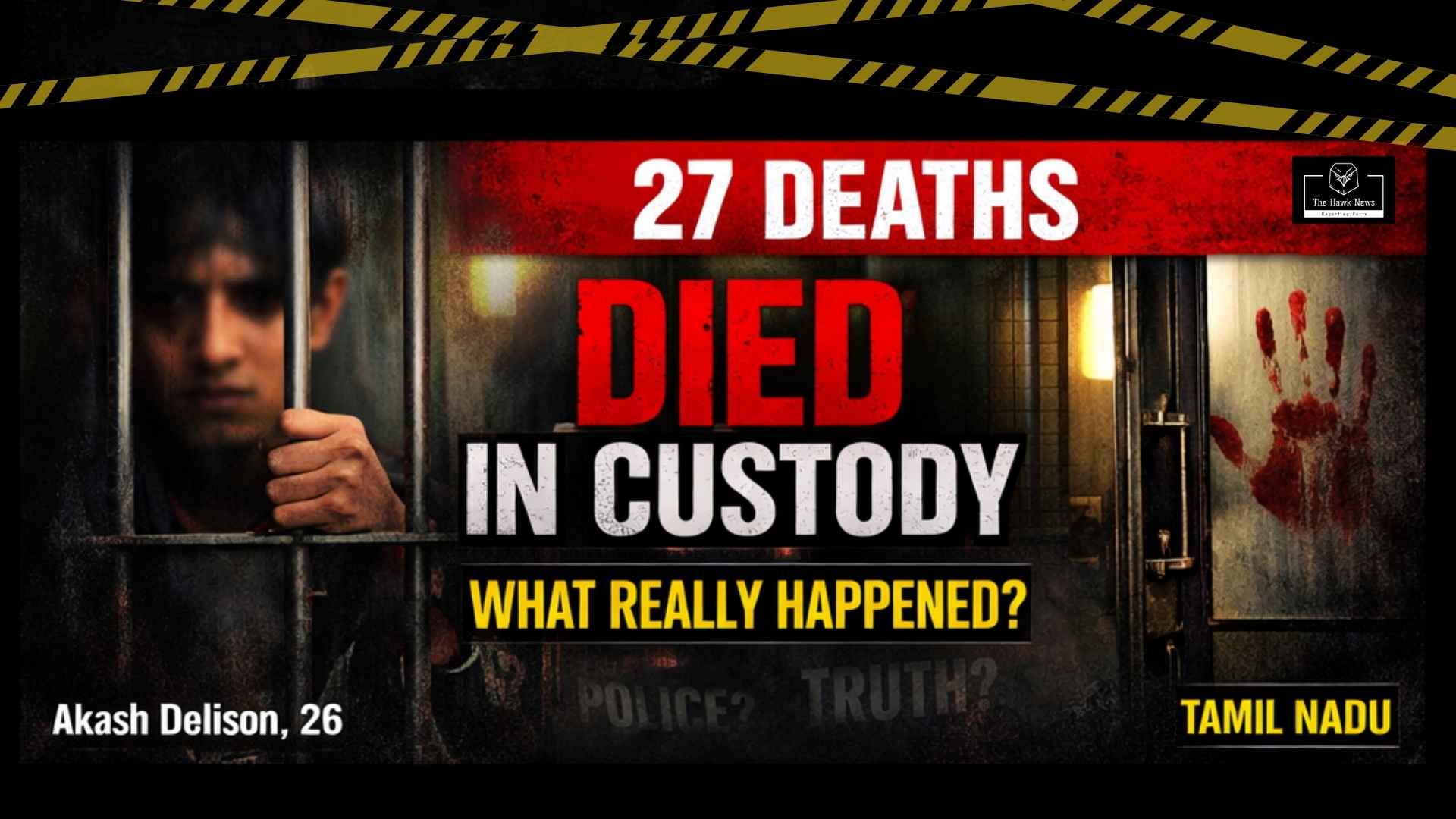
On a tense morning in Manamadurai, Sivaganga district, the death of 26-year-old Akash Delison did not pass as just another statistic. Picked up by the police and later declared dead, his family alleges what has become a chillingly familiar claim—custodial torture.
His death is not an isolated tragedy. It is the latest entry in a growing list that now stands at 27 custodial deaths in Tamil Nadu between May 2021 and August 2025—a figure that is increasingly difficult to dismiss as coincidence.
As Tamil Nadu inches closer to elections, the case has ignited outrage, fractured political unity, and revived long-standing concerns about police accountability.
The Numbers Behind the Narrative
Official data indicates that 27 individuals have died in police custody since the current government assumed office in May 2021. While each case carries its own circumstances, the recurring nature of such deaths raises a larger, uncomfortable question:
Are these isolated excesses—or symptoms of a systemic failure?
India’s legal framework is unambiguous on custodial conduct. The Supreme Court’s landmark guidelines in DK Basu vs State of West Bengal (1997) laid down strict procedures for arrest and detention, including:
- Mandatory arrest memos
- Medical examinations
- Informing relatives
- Protection from torture
Yet, repeated custodial death allegations suggest a persistent gap between law on paper and practice on the ground.
Inside the Akash Delison Case
According to preliminary reports, Akash Delison was taken into custody by local police in connection with a case. Within hours, he was declared dead.
Police sources have maintained that due procedure was followed. However, the victim’s family has strongly contested this version, alleging physical assault during interrogation.
The case quickly escalated beyond a local issue. Amid mounting public pressure and political scrutiny, the investigation was transferred to the Crime Branch-Criminal Investigation Department (CB-CID), a move often reserved for sensitive or high-profile cases.
The key questions now hinge on:
- Cause of death (awaiting detailed forensic clarity)
- Custodial protocol adherence
- Individual accountability within the police chain of command
Cracks Within the Alliance
In a rare and politically significant development, criticism has emerged not just from the opposition but from within the ruling alliance itself.
Thol Tirumavalavan publicly called for stringent action against those responsible, emphasizing that “justice must not be diluted, regardless of who is in power.”
Similarly, P Shanmugam demanded accountability, urging the government to ensure that “the rule of law prevails over institutional protection.”
Such statements underline a rare moment where political alignment has not translated into silence—exposing the seriousness of the issue.
Government’s Defence: Data vs Perception
The Tamil Nadu government has firmly defended its law-and-order record.
Officials point to a decline in murder and rape cases, arguing that the broader trend reflects improved policing and administrative efficiency. In response to criticism, government representatives have maintained that:
“Isolated incidents cannot overshadow the overall progress in maintaining law and order.”
They also highlight swift action in high-profile crimes, projecting responsiveness rather than negligence.
The Thoothukudi Case: Swift Justice, Selective Confidence?
One such example cited by the government is the rape and murder of a 17-year-old girl in Thoothukudi, which triggered statewide outrage.
Authorities moved quickly:
- Suspects were identified and arrested
- Investigation timelines were accelerated
- Public communication was tightly managed
While this case is presented as proof of administrative efficiency, critics argue it also exposes a contradiction:
Why does urgency appear consistent in public crimes, but questionable in custodial ones?
Opposition Offensive: ‘Whitewash’ Allegations
The opposition, led by the AIADMK, has seized upon the issue with sharp criticism.
Leaders have accused the government of:
- Manipulating crime data
- Downplaying custodial violence
- Attempting a “whitewash of systemic failures”
In strongly worded responses, opposition voices have argued that:
“Statistics cannot erase the reality of lives lost under state custody.”
The custodial death issue, thus, is no longer just a legal concern—it has become a political flashpoint.
A Pattern Beyond Politics
Custodial deaths are not new to Tamil Nadu—or India. But their persistence raises structural concerns:
- Pressure-driven policing
- Lack of independent oversight
- Delays in prosecution of accused officials
Data from across India has historically shown that convictions in custodial death cases remain rare, despite frequent allegations.
The gap between suspension and conviction continues to fuel public distrust.
Legal Lens: What the Law Demands
Under Indian law:
- Custodial torture is a violation of Article 21 (Right to Life) of the Constitution
- Police excesses can attract charges under the Indian Penal Code
- The National Human Rights Commission (NHRC) mandates reporting and inquiry into all custodial deaths
The Supreme Court has repeatedly emphasized that:
“Custodial violence is a naked violation of human dignity.”
Yet, enforcement remains inconsistent.
Elections vs Accountability
As Tamil Nadu moves toward elections, political discourse is increasingly dominated by alliances, seat-sharing, and campaign narratives.
In that noise, critical issues like custodial deaths risk being reduced to momentary outrage rather than sustained debate.
The Akash Delison case briefly broke through that silence—but whether it leads to systemic reform remains uncertain.
The Unanswered Question
For every statistic cited and every political statement made, one question lingers:
Can a democracy afford to normalize deaths within its own custody?
As ballots are prepared and alliances negotiated, the answer may ultimately lie not in speeches—but in whether justice is delivered where the system itself stands accused.