
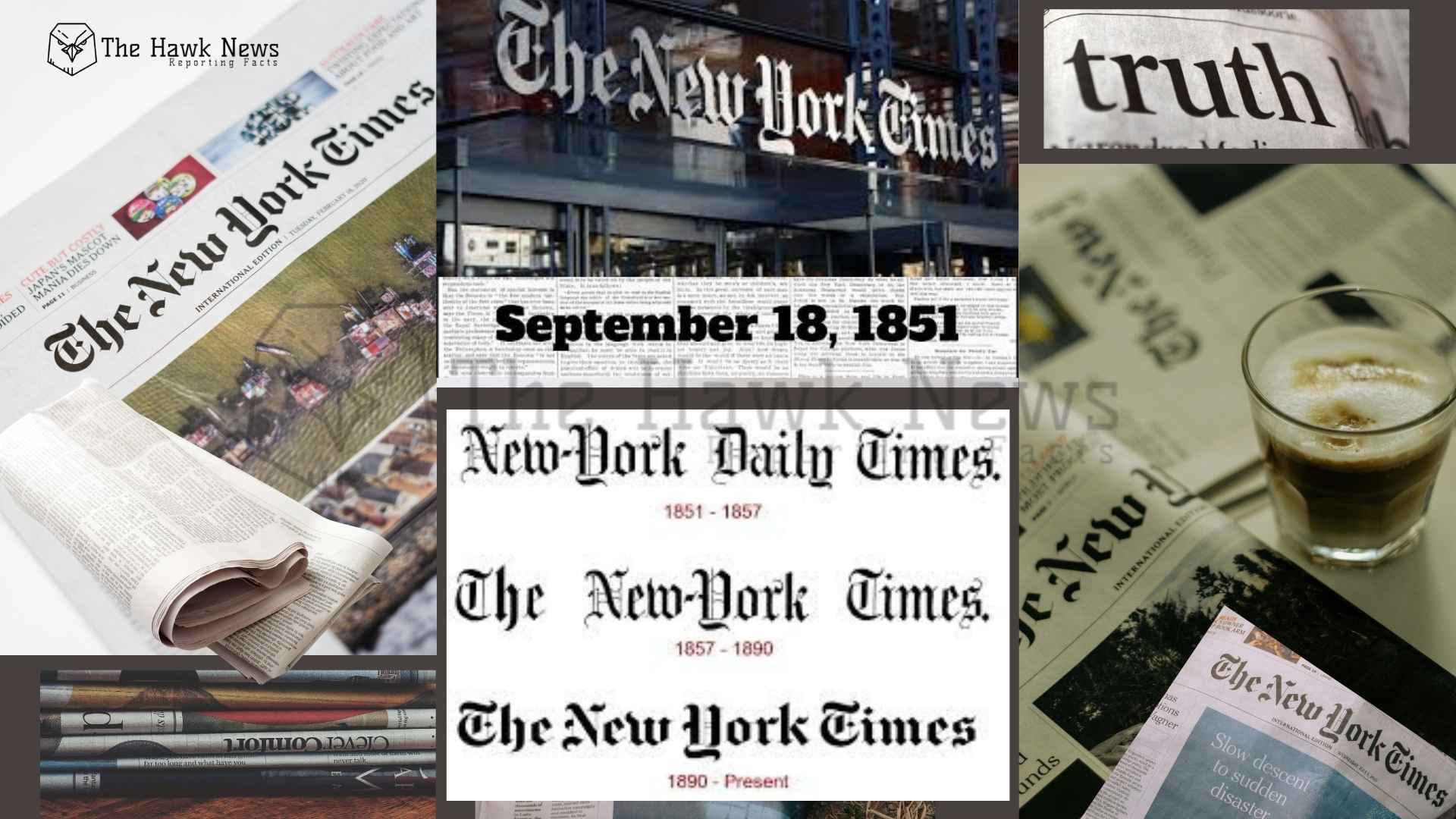
On September 18, 1851, a small yet ambitious newspaper made its debut in New York City—the New-York Daily Times, known today as The New York Times.
Priced at one cent per copy, it promised accurate, fair, and independent reporting in an era dominated by partisan and sensationalist journalism.
Over the next 170 years, this publication would become a global symbol of journalistic integrity, shaping the way news is reported and consumed around the world.
The Founding Visionaries:
The New York Times was founded by Henry Jarvis Raymond, a politician and journalist, and George Jones, a banker.
Raymond, who would later serve as a co-founder of the Republican Party, envisioned a newspaper that would rise above the “penny press” sensationalism that dominated mid-19th-century New York.
Jones brought financial backing and business acumen, ensuring that the paper could sustain itself while maintaining editorial independence.
Raymond’s guiding principle was simple but revolutionary for the time: news should inform rather than manipulate, and truth should guide public discourse. Unlike many contemporary newspapers that were openly partisan, the New-York Daily Times pledged to provide readers with carefully verified facts and thoughtful analysis, setting a new standard in American journalism.
The First Issue:
The inaugural issue, published on September 18, 1851, marked the beginning of a new era. The paper covered a variety of topics, including local politics, economic developments, social issues, and international news.
Advertisements and notices for events and services also filled the pages, reflecting the daily life of New Yorkers at the time.
Even in its first edition, the New-York Daily Times demonstrated the principles that would define its legacy: thorough reporting, attention to detail, and a commitment to factual accuracy.
It was a newspaper designed not only to report events but to provide context and analysis, helping readers make sense of the world around them.
Early Challenges and Growth:
Launching a newspaper in 1851 was no small feat. The market was crowded with partisan papers that thrived on sensationalism. Yet, Raymond and Jones were confident that a publication based on integrity and meticulous reporting could succeed.
Slowly but steadily, the paper gained readership among New Yorkers who valued credible information over gossip and scandal.
By the 1850s, the Times had begun expanding its coverage beyond local news to include national and international reporting, a move that would later become one of its defining features.
Its commitment to quality attracted skilled journalists and editors, many of whom would go on to make significant contributions to American media.
Setting a Standard in Journalism:
The New York Times quickly distinguished itself through editorial independence and professional reporting practices. It pioneered separating news from opinion, ensuring that editorials did not influence factual reporting.
Correspondents were sent to cover events firsthand, emphasizing on-the-ground reporting rather than secondhand accounts. Fact-checking became a cornerstone of its operations, establishing a benchmark for newspapers across the country.
These practices were revolutionary in an era where newspapers were often tools of political parties, and they helped position the Times as a reliable source for citizens seeking informed perspectives. Its motto, “All the News That’s Fit to Print,” coined later in 1896, would become synonymous with journalistic integrity and dedication to the truth.
Coverage of Major Historical Events:
From its inception, the Times documented pivotal moments in history. It covered the Civil War, providing detailed accounts of battles, political debates, and social changes.
Its reporting on Reconstruction, industrialization, and social reforms shaped public understanding of America’s transformation.
In the 20th century, the Times continued to make history through coverage of world wars, civil rights movements, and political scandals, earning respect for investigative reporting.
Landmark stories, such as the exposure of the Watergate scandal and coverage of global conflicts, solidified its reputation as a newspaper committed to accountability and truth.
Technological and Editorial Evolution:
The New York Times evolved with technology, embracing telegraph reporting in the 19th century, photojournalism in the early 20th century, and digital media in the 21st century. It adapted to changing reader habits while maintaining core values: accuracy, depth, and fairness.
The paper also expanded globally, with bureaus around the world, ensuring that readers had access to comprehensive international news. Its editorial voice became influential not just in the United States but on the global stage, shaping debates on politics, culture, economics, and human rights.
Impact on Global Journalism:
The New York Times’ influence extends far beyond its readership. It has shaped professional standards for newspapers worldwide, inspiring journalists and editors to prioritize integrity, thoroughness, and independence.
Its approach to separating news from opinion, verifying facts rigorously, and providing in-depth analysis has become a model for modern journalism.
Additionally, the Times has served as a training ground for generations of journalists, many of whom have gone on to lead other major media organizations. Its emphasis on investigative reporting, ethical standards, and global perspective has had a ripple effect across the media landscape.
Challenges in the Modern Era:
Despite its historical prestige, the Times, like all traditional media outlets, has faced challenges in the digital age. The rise of social media, the 24-hour news cycle, and the spread of misinformation have transformed how news is consumed.
The newspaper has responded by expanding its digital presence, offering online subscriptions, and developing multimedia reporting while maintaining its commitment to factual accuracy and editorial rigor.
Economic pressures have also tested the industry, requiring innovation in revenue models and content delivery. Yet, the Times continues to uphold its legacy of credible reporting, showing that a commitment to truth can endure even amid rapid technological and cultural change.
Legacy and Continuing Relevance:
From its first issue in 1851 to today, The New York Times represents more than a newspaper—it embodies the principles of responsible journalism. It has chronicled history, shaped public opinion, and influenced policy through investigative reporting and informed analysis.
Its motto, “All the News That’s Fit to Print,” encapsulates the ethos established by Henry Jarvis Raymond and George Jones: that journalism should serve the public interest, uphold accuracy, and remain independent from undue influence.
Over 170 years later, these values continue to guide its reporting and define its reputation as one of the world’s most respected newspapers.
Conclusion:
The publication of the first issue of The New York Times on September 18, 1851, was more than the launch of a newspaper—it was the beginning of a journalistic legacy that transformed how news is reported, consumed, and valued.
Through wars, social upheavals, technological revolutions, and cultural shifts, the Times has remained committed to informing the public, holding power accountable, and setting global standards for journalism.
As media continues to evolve, the story of The New York Times reminds us that the foundation of credible journalism is timeless: dedication to truth, clarity, and responsibility.
The paper’s journey from a one-cent daily in New York to a globally influential media institution underscores the enduring power of the press in shaping societies and preserving democracy.